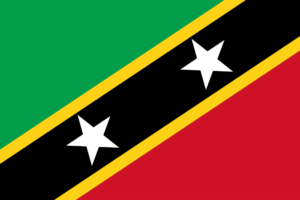
Saint Kitts and Nevis
Carib Indians occupied the islands of the West Indies for hundreds of years before the British and French began settlement in 1623. During the 17th century, Saint Kitts became the premier base for British and French expansion into the Caribbean.
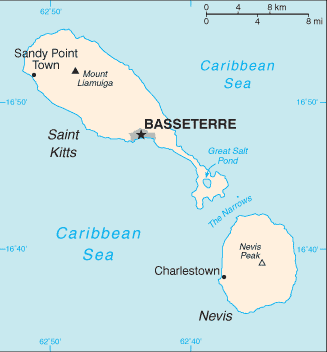
Location
Source: CIA World Factbook (public domain)
Geography
smallest country in the Western Hemisphere in terms of both area and population; the two volcanic islands are separated by a 3-km-wide (9-mi-wide) channel called The Narrows; on the southern tip of baseball-bat-shaped Saint Kitts lies the Great Salt Pond; Nevis Peak sits in the center of its ball-shaped namesake island
Source: CIA World Factbook (public domain)
History
Carib Indians occupied the islands of the West Indies for hundreds of years before the British and French began settlement in 1623. During the 17th century, Saint Kitts became the premier base for British and French expansion into the Caribbean. The French ceded the territory to the UK in 1713. At the turn of the 18th century, Saint Kitts was the richest British Crown Colony per capita in the Caribbean, a result of the sugar trade. Although small in size and separated by only 3 km (2 mi) of water, Saint Kitts and Nevis were viewed and governed as different states until the late-19th century, when the British forcibly unified them along with the island of Anguilla. In 1967, the island territory of Saint Christopher-Nevis-Anguilla became an associated state of the UK with full internal autonomy. The island of Anguilla rebelled and was allowed to secede in 1971. The remaining islands achieved independence in 1983 as Saint Kitts and Nevis. In 1998, a referendum on Nevis to separate from Saint Kitts fell short of the necessary two-thirds majority.
Source: CIA World Factbook (public domain)
Government
federal parliamentary democracy under a constitutional monarchy; a Commonwealth realm. Independence: 19 September 1983 (from the UK)
Source: CIA World Factbook (public domain)
Economy
high-income, tourism-based Caribbean OECS economy; better debt balancing; CARICOM and ECCU member; growing offshore financial and telecommunications hub; environmentally fragile; unique citizenship-driven growth model
Source: CIA World Factbook (public domain)
Suggested Reading
Adopt This Country
Will you help us keep the Saint Kitts and Nevis page accurate and up to date?
Adopt This Country