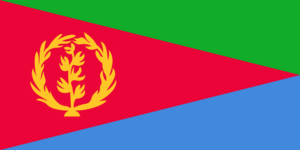
Eritrea
Eritrea won independence from Italian colonial control in 1941, but the UN only established it as an autonomous region within the Ethiopian federation in 1952, after a decade of British administrative control.
Location
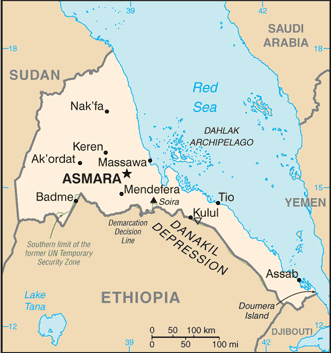
Source: CIA World Factbook (public domain)
Geography
strategic geopolitical position along world's busiest shipping lanes
Source: CIA World Factbook (public domain)
History
Eritrea won independence from Italian colonial control in 1941, but the UN only established it as an autonomous region within the Ethiopian federation in 1952, after a decade of British administrative control. Ethiopia's full annexation of Eritrea as a province 10 years later sparked a violent 30-year conflict for independence that ended in 1991 with Eritrean fighters defeating government forces. Eritreans overwhelmingly approved independence in a 1993 referendum. ISAIAS Afwerki has been Eritrea's only president since independence; his rule, particularly since 2001, has been characterized by highly autocratic and repressive actions. His government has created a highly militarized society by instituting an unpopular program of mandatory conscription into national service -- divided between military and civilian service -- of indefinite length. A two-and-a-half-year border war with Ethiopia that erupted in 1998 ended under UN auspices in 2000. Ethiopia rejected a subsequent 2007 Eritrea-Ethiopia Boundary Commission (EEBC) demarcation. More than a decade of a tense “no peace, no war” stalemate ended in 2018 when the newly elected Ethiopian prime minister accepted the EEBC’s 2007 ruling, and the two countries signed declarations of peace and friendship. Eritrean leaders then engaged in intensive diplomacy around the Horn of Africa, bolstering regional peace, security, and cooperation, as well as brokering rapprochements between governments and opposition groups. In 2018, the UN Security Council lifted an arms embargo that had been imposed on Eritrea since 2009, after the UN Somalia-Eritrea Monitoring Group reported they had not found evidence of Eritrean support in recent years for al-Shabaab. The country’s rapprochement with Ethiopia led to a resumption of economic ties, but the level of air transport, trade, and tourism have remained roughly the same since late 2020. The Eritrean economy remains agriculture-dependent, and the country is still one of Africa’s poorest nations. Eritrea faced new international condemnation and US sanctions in mid-2021 for its participation in the war in Ethiopia’s Tigray Regional State, where Eritrean forces were found to have committed war crimes and crimes against humanity. As most Eritrean troops were departing northern Ethiopia in January 2023, ISAIAS began a series of diplomatic engagements aimed at bolstering Eritrea’s foreign partnerships and regional influence. Despite the country's improved relations with its neighbors, ISAIAS has not let up on repression, and conscription and militarization continue.
Source: CIA World Factbook (public domain)
Government
authoritarian. Independence: 24 May 1993 (from Ethiopia)
Source: CIA World Factbook (public domain)
Economy
largely agrarian economy with a significant mining sector; substantial fiscal surplus due to tight controls; high and vulnerable debts; increased Ethiopian trade and shared port usage decreasing prices; financial and economic data integrity challenges
Source: CIA World Factbook (public domain)
Suggested Reading
Adopt This Country
Will you help us keep the Eritrea page accurate and up to date?
Adopt This Country