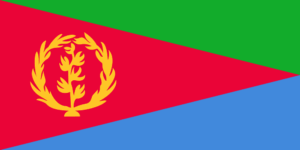
Eritrea
The Country of the Week

Quick Facts
- Capital
- Asmara
- Population
- 6,416,435 (2025 est.)
- Area
- 117,600 sq km
- Government
- authoritarian
- Languages
- Tigrinya (official), Arabic (official), English (official), Tigre, Kunama, Afar, other Cushitic languages
- Religions
- Eritrean Orthodox, Roman Catholic, Evangelical Lutheran, Sunni Muslim
- Ethnic Groups
- Tigrinya 50%, Tigre 30%, Saho 4%, Afar 4%, Kunama 4%, Bilen 3%, Hedareb/Beja 2%, Nara 2%, Rashaida 1% (2021 est.)
- Currency
- nakfa (ERN)
- Life Expectancy
- 67.5 years (2024 est.)
- Internet Domain
- .er
- Climate
- hot, dry desert strip along Red Sea coast; cooler and wetter in the central highlands (up to 61 cm of rainfall annually, heaviest June to September); semiarid in western hills and lowlands
- Terrain
- dominated by extension of Ethiopian north-south trending highlands, descending on the east to a coastal desert plain, on the northwest to hilly terrain and on the southwest to flat-to-rolling plains
- Natural Resources
- gold, potash, zinc, copper, salt, possibly oil and natural gas, fish
- Major Exports
- copper ore, zinc ore, gold, garments, liquor (2023)
Source: CIA World Factbook (public domain)
Overview
Eritrea won independence from Italian colonial control in 1941, but the UN only established it as an autonomous region within the Ethiopian federation in 1952, after a decade of British administrative control.