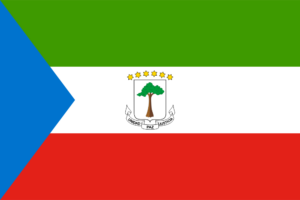
Equatorial Guinea
Equatorial Guinea consists of a continental territory and five inhabited islands; it is one of the smallest countries by area and population in Africa.
Location
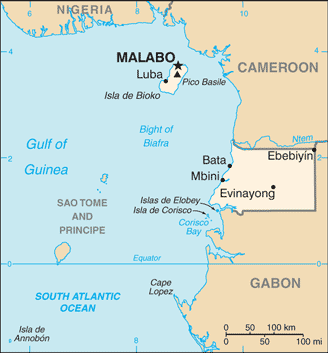
Source: CIA World Factbook (public domain)
Geography
insular and continental regions widely separated; despite its name, no part of the equator passes through Equatorial Guinea -- the mainland part of the country is located just north of the equator
Source: CIA World Factbook (public domain)
History
Equatorial Guinea consists of a continental territory and five inhabited islands; it is one of the smallest countries by area and population in Africa. The mainland region was most likely predominantly inhabited by Pygmy ethnic groups prior to the migration of various Bantu-speaking ethnic groups around the second millennium BC. The island of Bioko, the largest of Equatorial Guinea’s five inhabited islands and the location of the country’s capital of Malabo, has been occupied since at least 1000 B.C. In the early 1470s, Portuguese explorers landed on Bioko Island, and Portugal soon after established control of the island and other areas of modern Equatorial Guinea. In 1778, Portugal ceded its colonial hold over present-day Equatorial Guinea to Spain in the Treaty of El Pardo. The borders of modern-day Equatorial Guinea would evolve between 1778 and 1968 as the area remained under European colonial rule.In 1968, Equatorial Guinea was granted independence from Spain and elected Francisco MACIAS NGUEMA as its first president. MACIAS consolidated power soon after his election and ruled brutally for over a decade. Under his regime, Equatorial Guinea experienced mass suppression, purges, and killings. Some estimates indicate that a third of the population either went into exile or was killed under MACIAS’ rule. In 1979, present-day President OBIANG Nguema Mbasogo, then a senior military officer, deposed MACIAS in a violent coup. OBIANG has ruled since and has been elected in non-competitive contests several times, most recently in 2022. The president exerts near-total control over the political system. Equatorial Guinea experienced rapid economic growth in the early years of the 21st century due to the discovery of large offshore oil reserves in 1996. Production peaked in 2004 and has declined since. The country's economic windfall from oil production resulted in massive increases in government revenue, a significant portion of which was earmarked for infrastructure development. Systemic corruption, however, has hindered socio-economic development, and the population has seen only limited improvements to living standards. Equatorial Guinea continues to seek to diversify its economy, increase foreign investment, and assume a greater role in regional and international affairs. 
Source: CIA World Factbook (public domain)
Government
presidential republic. Independence: 12 October 1968 (from Spain)
Source: CIA World Factbook (public domain)
Economy
growing CEMAC economy and new OPEC member; large oil and gas reserves; targeting economic diversification and poverty reduction; still recovering from CEMAC crisis; improving public financial management; persistent poverty; hard-hit by COVID-19
Source: CIA World Factbook (public domain)
Suggested Reading
Adopt This Country
Will you help us keep the Equatorial Guinea page accurate and up to date?
Adopt This Country