
Estonia
After centuries of Danish, Swedish, German, and Russian rule, Estonia attained independence in 1918.
Location
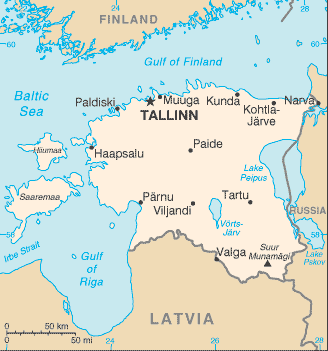
Source: CIA World Factbook (public domain)
Geography
the mainland terrain is flat, boggy, and partly wooded; over 1,500 islands lie offshore
Source: CIA World Factbook (public domain)
History
After centuries of Danish, Swedish, German, and Russian rule, Estonia attained independence in 1918. Forcibly incorporated into the USSR in 1940 -- an action never recognized by the US and many other countries -- it regained its freedom in 1991 with the collapse of the Soviet Union. Since the last Russian troops left in 1994, Estonia has been free to promote economic and political ties with the West. It joined both NATO and the EU in 2004, formally joined the OECD in 2010, and adopted the euro as its official currency in 2011.
Source: CIA World Factbook (public domain)
Government
parliamentary republic. Independence: 24 February 1918 (from Soviet Russia); 20 August 1991 (declared from the Soviet Union); 6 September 1991 (recognized by the Soviet Union)
Source: CIA World Factbook (public domain)
Economy
high-income, service-based EU and eurozone economy; rebound in exports playing a role in economic recovery; rising food prices contributing to inflation; decrease in labor force participation and rising unemployment rate; recovery depends on boosting private investment and productivity rates
Source: CIA World Factbook (public domain)
Suggested Reading
Adopt This Country
Will you help us keep the Estonia page accurate and up to date?
Adopt This Country