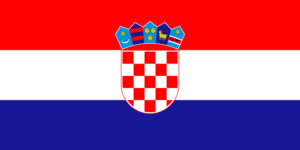
Croatia
The lands that today comprise Croatia were part of the Austro-Hungarian Empire until the end of World War I. In 1918, the Croats, Serbs, and Slovenes formed a kingdom known after 1929 as Yugoslavia.
Location
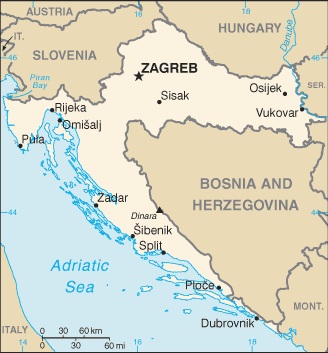
Source: CIA World Factbook (public domain)
Geography
controls most land routes from Western Europe to the Aegean Sea and Turkish Straits; most Adriatic Sea islands lie off the coast of Croatia -- some 1,200 islands, islets, ridges, and rocks
Source: CIA World Factbook (public domain)
History
The lands that today comprise Croatia were part of the Austro-Hungarian Empire until the end of World War I. In 1918, the Croats, Serbs, and Slovenes formed a kingdom known after 1929 as Yugoslavia. Following World War II, Yugoslavia became a federal independent communist state consisting of six socialist republics, including Croatia, under the strong hand of Josip Broz, aka TITO. Although Croatia declared its independence from Yugoslavia in 1991, it took four years of sporadic, but often bitter, fighting before Yugoslav forces were cleared from Croatian lands, along with a majority of Croatia's ethnic Serb population. Under UN supervision, the last Serb-held enclave in eastern Slavonia was returned to Croatia in 1998. The country joined NATO in 2009 and the EU in 2013. In January 2023, Croatia further integrated into the EU by joining the Eurozone and the Schengen Area.
Source: CIA World Factbook (public domain)
Government
parliamentary republic. Independence: 25 June 1991 (from Yugoslavia); notable earlier dates: ca. 925 (Kingdom of Croatia established), 1 December 1918 (Kingdom of Serbs, Croats, and Slovenes established, later became Yugoslavia)
Source: CIA World Factbook (public domain)
Economy
upper-middle-income Balkan economy; newest euro user (introduced in 2023); increased investments from EU structural funds and tourism sector contributing to strong but moderating economic growth; declining energy prices and restrictive monetary policy easing inflation; historically low unemployment rate with labor shortages within services and manufacturing sectors
Source: CIA World Factbook (public domain)
Suggested Reading
Adopt This Country
Will you help us keep the Croatia page accurate and up to date?
Adopt This Country