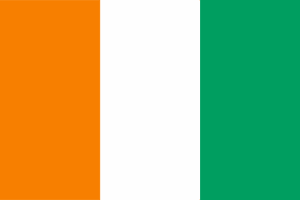
Cote d’Ivoire
Various small kingdoms ruled the area of Cote d'Ivoire between the 15th and 19th centuries, when European explorers arrived and then began to expand their presence. In 1844, France established a protectorate.
Location
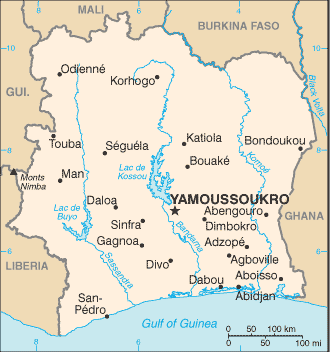
Source: CIA World Factbook (public domain)
Geography
most of the inhabitants live along the sandy coastal region; apart from the capital area, the forested interior is sparsely populated
Source: CIA World Factbook (public domain)
History
Various small kingdoms ruled the area of Cote d'Ivoire between the 15th and 19th centuries, when European explorers arrived and then began to expand their presence. In 1844, France established a protectorate. During this period, many of these kingdoms and tribes fought to maintain their cultural identities -- some well into the 20th century. For example, the Sanwi kingdom -- originally founded in the 17th century -- tried to break away from Cote d’Ivoire and establish an independent state in 1969. Cote d’Ivoire achieved independence from France in 1960 but has maintained close ties. Foreign investment and the export and production of cocoa drove economic growth that led Cote d’Ivoire to become one of the most prosperous states in West Africa. Then in 1999, a military coup overthrew the government, and a year later, junta leader Robert GUEI held rigged elections and declared himself the winner. Popular protests forced him to step aside, and Laurent GBAGBO was elected. Ivoirian dissidents and members of the military launched a failed coup in 2002 that developed into a civil war. In 2003, a cease-fire resulted in rebels holding the north, the government holding the south, and peacekeeping forces occupying a buffer zone in the middle. In 2007, President GBAGBO and former rebel leader Guillaume SORO signed an agreement in which SORO joined GBAGBO's government as prime minister. The two agreed to reunite the country by dismantling the buffer zone, integrating rebel forces into the national armed forces, and holding elections. In 2010, Alassane Dramane OUATTARA won the presidential election, but GBAGBO refused to hand over power, resulting in five months of violent conflict. Armed OUATTARA supporters and UN and French troops eventually forced GBAGBO to step down in 2011. OUATTARA won a second term in 2015 and a controversial third term in 2020 -- despite the two-term limit in the Ivoirian constitution -- in an election boycotted by the opposition. Through political compromise with OUATTARA, the opposition participated peacefully in 2021 legislative elections and won a substantial minority of seats. Also in 2021, the International Criminal Court in The Hague ruled on a final acquittal for GBAGBO, who was on trial for crimes against humanity, paving the way for GBAGBO’s return to Abidjan the same year. GBAGBO has publicly met with OUATTARA since his return as a demonstration of political reconciliation.
Source: CIA World Factbook (public domain)
Government
presidential republic. Independence: 7 August 1960 (from France)
Source: CIA World Factbook (public domain)
Economy
one of West Africa’s most influential, stable, and rapidly developing economies; poverty declines in urban but increases in rural areas; strong construction sector and increasingly diverse economic portfolio; increasing but manageable public debt; large labor force in agriculture
Source: CIA World Factbook (public domain)
Suggested Reading
Adopt This Country
Will you help us keep the Cote d’Ivoire page accurate and up to date?
Adopt This Country