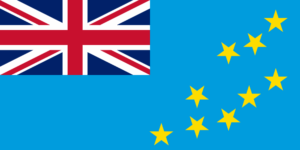
Tuvalu
Voyagers from either Samoa or Tonga first populated Tuvalu in the first millennium A.D., and the islands provided a stepping-stone for various Polynesian communities that subsequently settled in Melanesia and Micronesia.
Location
Source: CIA World Factbook (public domain)
Geography
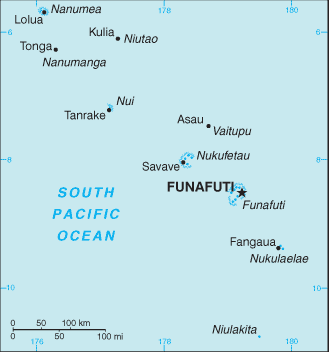
one of the smallest and most remote countries on earth; six of the nine coral atolls -- Nanumea, Nui, Vaitupu, Nukufetau, Funafuti, and Nukulaelae -- have lagoons open to the ocean; Nanumaya and Niutao have landlocked lagoons; Niulakita does not have a lagoon
Source: CIA World Factbook (public domain)
History
Voyagers from either Samoa or Tonga first populated Tuvalu in the first millennium A.D., and the islands provided a stepping-stone for various Polynesian communities that subsequently settled in Melanesia and Micronesia. Tuvalu eventually came under Samoan and Tongan spheres of influence, although proximity to Micronesia allowed some Micronesian communities to flourish in Tuvalu, in particular on Nui Atoll. In the late 1700s and early 1800s, a series of American, British, Dutch, and Russian ships visited the islands, which were named the Ellice Islands in 1819. The UK declared a protectorate over islands in 1892 and merged them with the Micronesian Gilbert Islands. The Gilbert and Ellice Islands Protectorate became a colony in 1916. During World War II, the US set up military bases on a few islands, and in 1943, after Japan captured many of the northern Gilbert Islands, the UK transferred administration of the colony southward to Funafuti. After the war, Tarawa in the Gilbert Islands was once again made the colony’s capital, and the center of power was firmly in the Gilbert Islands, including the colony’s only secondary school. Amid growing tensions with the Gilbertese, Tuvaluans voted to secede from the colony in 1974, were granted self-rule in 1975, and gained independence in 1978 as Tuvalu. In 1979, the US relinquished its claims to the Tuvaluan islands in a treaty of friendship.
Source: CIA World Factbook (public domain)
Government
parliamentary democracy under a constitutional monarchy; a Commonwealth realm. Independence: 1 October 1978 (from the UK)
Source: CIA World Factbook (public domain)
Economy
upper middle-income Pacific island economy; extremely environmentally fragile; currency pegged to Australian dollar; large international aid recipient; subsistence agrarian sector; Te Kakeega sustainable development; domain name licensing incomes
Source: CIA World Factbook (public domain)
Suggested Reading
Adopt This Country
Will you help us keep the Tuvalu page accurate and up to date?
Adopt This Country