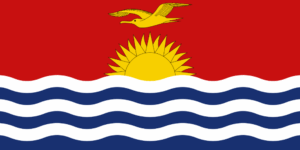
Kiribati
Kiribati is made up of three distinct island groups -- the Gilbert Islands, the Line Islands, and the Phoenix Islands. The first Austronesian voyagers arrived in the Gilbert Islands as early as 3000 B.C., but these islands were not widely settled until about A.D.
Location
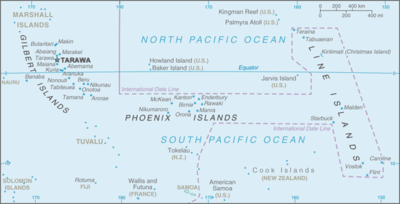
Source: CIA World Factbook (public domain)
Geography
21 of the 33 islands are inhabited; Banaba (Ocean Island) in Kiribati is one of the three great phosphate rock islands in the Pacific Ocean -- the others are Makatea in French Polynesia, and Nauru; Kiribati is the only country in the world to fall into all four hemispheres (northern, southern, eastern, and western)
Source: CIA World Factbook (public domain)
History
Kiribati is made up of three distinct island groups -- the Gilbert Islands, the Line Islands, and the Phoenix Islands. The first Austronesian voyagers arrived in the Gilbert Islands as early as 3000 B.C., but these islands were not widely settled until about A.D. 200 by Micronesians. Around 1300, Samoans and Tongans invaded the southern Gilbert Islands, then known as Tungaru, bringing Polynesian cultural elements with them. Later arrivals of Fijians brought Melanesian elements to the Gilbert Islands, and extensive intermarriage between the Micronesian, Polynesian, and Melanesian people led to the creation of what would become Gilbertese cultural traditions by the time Europeans spotted the islands in the 1600s. The Phoenix Islands and Line Islands were both visited by various Melanesian and Polynesian peoples, but their isolation and lack of natural resources meant that long-term settlements were not possible. Both island groups were uninhabited by the time of European contact. Kiribati experienced sustained European contact by the 1760s; all three island groups were named and charted by 1826. American whaling ships frequently passed through the islands, and the UK declared a protectorate over the Gilbert and nearby Ellice Islands in 1892, in an attempt to block growing US influence. Phosphate-rich Banaba Island was annexed to the protectorate in 1900. In 1916, the protectorate became a colony, and some Line Islands were added in 1916 and 1919, with the final ones added in 1972. The Phoenix Islands were added to the colony in 1937, and the UK agreed to share jurisdiction of some with the US because of their strategic location for aviation. During World War II, the islands were occupied by Japanese forces but were ejected by US amphibious assaults. The Ellice Islands became its own colony in 1974 and was renamed Tuvalu for “eight standing together” in 1975. The Gilbert Islands became fully self-governing in 1977 and independent in 1979 under the new name of Kiribati, the Gilbertese spelling of Gilberts. The US relinquished all claims to the sparsely inhabited Phoenix and Line Islands in a 1979 treaty of friendship.In 2012, Kiribati purchased a 22 sq km (8.5 sq mi) plot of land in Fiji for potential eventual resettlement of its population because of climate change, and in 2014 Fijian Prime Minister Voreqe BAINIMARAMA said residents of Kiribati would be welcome to relocate to Fiji if their country is swamped by rising sea levels.
Source: CIA World Factbook (public domain)
Government
presidential republic. Independence: 12 July 1979 (from the UK)
Source: CIA World Factbook (public domain)
Economy
lower-middle income, Pacific island economy; environmentally fragile; sizable remittances; key phosphate mining fund; tourism and fishing industries; public sector-dominated economy; recent withdrawal from Pacific Islands Forum; ongoing constitutional crisis
Source: CIA World Factbook (public domain)
Pray for This Country
Kiribati is a nation shaped by the ocean that surrounds it — both a source of daily livelihood and, increasingly, an existential threat as rising seas erode its low-lying coastline. As you pray this week, hold in mind both the physical vulnerability I-Kiribati families face and the deep communal faith that has sustained island life for generations.
- Pray for wisdom for Kiribati's leaders as they navigate the realities of climate change and plan for their people's long-term future.
- Pray for families in outer island communities who face growing isolation as young people migrate to South Tarawa or overseas for work.
- Pray for the health and safety of I-Kiribati seafarers who spend long months away from home crewing foreign merchant ships.
- Pray for the churches of Kiribati to be a source of hope, unity, and practical care as communities face an uncertain future.
- Pray for clean water, adequate sanitation, and strong health care access, particularly in the increasingly crowded capital area.
Mission Emphasis
Christian faith is deeply woven into I-Kiribati community life, with the Kiribati Uniting Church (rooted in 19th-century Congregationalist mission work) and the Roman Catholic Church representing the two largest bodies. Ongoing ministry needs include theological training for local pastors serving remote outer islands, resources for youth discipleship amid rapid social change, and practical partnerships that address climate resilience alongside spiritual care.
Suggested Reading
Adopt This Country
Will you help us keep the Kiribati page accurate and up to date?
Adopt This Country