
Australia
Aboriginal Australians arrived on the continent at least 60,000 years ago and developed complex hunter-gatherer societies and oral histories.
Location
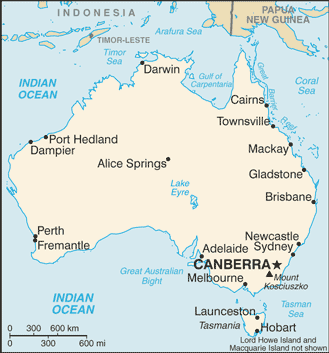
Source: CIA World Factbook (public domain)
Geography
note 1: world's smallest continent but sixth-largest country; the largest country in Oceania, the largest country entirely in the Southern Hemisphere, and the largest country without land bordersnote 2: the Great Dividing Range that runs along eastern Australia is that continent’s longest mountain range and the third-longest land-based range in the world; the term "Great Dividing Range" refers to the fact that the mountains form a watershed crest from which all of the rivers of eastern Australia flow – east, west, north, and southnote 3: Australia is the only continent without glaciers; it is the driest inhabited continent on earth; Perth on the west coast is home to the invigorating sea breeze known as the "Fremantle Doctor," one of the most consistent winds in the world; Australia hosts 10% of the world's biodiversity, and a great number of its flora and fauna exist nowhere else in the world
Source: CIA World Factbook (public domain)
History
Aboriginal Australians arrived on the continent at least 60,000 years ago and developed complex hunter-gatherer societies and oral histories. Dutch navigators led by Abel TASMAN were the first Europeans to land in Australia in 1606, and they mapped the western and northern coasts. They named the continent New Holland but made no attempts to permanently settle it. In 1770, Englishman James COOK sailed to the east coast of Australia, named it New South Wales, and claimed it for Great Britain. In 1788 and 1825 respectively, Great Britain established New South Wales and then Tasmania as penal colonies. Great Britain and Ireland sent more than 150,000 convicts to Australia before ending the practice in 1868. As Europeans began settling areas away from the coasts, they came into more direct contact with Aboriginal Australians. Europeans also cleared land for agriculture, impacting Aboriginal Australians’ ways of life. These issues, along with disease and a policy in the 1900s that forcefully removed Aboriginal children from their parents, reduced the Aboriginal Australian population from more than 700,000 pre-European contact to a low of 74,000 in 1933.Four additional colonies were established in Australia in the mid-1800s: Western Australia (1829), South Australia (1836), Victoria (1851), and Queensland (1859). Gold rushes beginning in the 1850s brought thousands of new immigrants to New South Wales and Victoria, helping to reorient Australia away from its penal colony roots. In the second half of the 1800s, the colonies were all gradually granted self-government, and in 1901, they federated and became the Commonwealth of Australia. Australia contributed more than 400,000 troops to Allied efforts during World War I, and Australian troops played a large role in the defeat of Japanese troops in the Pacific in World War II. Australia severed most constitutional links with the UK in 1942 but remained part of the British Commonwealth. Australia’s post-war economy boomed and by the 1970s, racial policies that prevented most non-Whites from immigrating to Australia were removed, greatly increasing Asian immigration to the country. In recent decades, Australia has become an internationally competitive, advanced market economy due in large part to economic reforms adopted in the 1980s and its proximity to East and Southeast Asia. In the early 2000s, Australian politics became unstable with frequent attempts to oust party leaders, including five changes of prime minister between 2010 and 2018. As a result, both major parties instituted rules to make it harder to remove a party leader.
Source: CIA World Factbook (public domain)
Government
federal parliamentary democracy under a constitutional monarchy; a Commonwealth realm. Independence: 1 January 1901 (from the federation of UK colonies)
Source: CIA World Factbook (public domain)
Economy
high-income and globally integrated economy; strong mining, manufacturing, and service sectors driving slow but steady growth; net exporter, driven by commodities to East Asian trade partners; weak productivity and aging population straining labor force participation
Source: CIA World Factbook (public domain)
Suggested Reading
Adopt This Country
Will you help us keep the Australia page accurate and up to date?
Adopt This Country