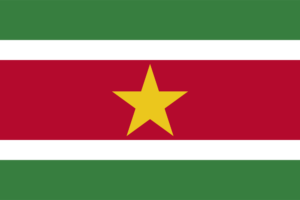
Suriname
The Spaniards first explored Suriname in the 16th century, and the English then settled it in the mid-17th century. Suriname became a Dutch colony in 1667. With the abolition of African slavery in 1863, workers were brought in from India and Java.
Location
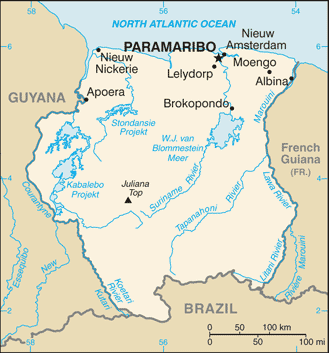
Source: CIA World Factbook (public domain)
Geography
smallest independent country on the South American continent; mostly tropical rainforest; great diversity of flora and fauna; relatively small population, mostly along the coast
Source: CIA World Factbook (public domain)
History
The Spaniards first explored Suriname in the 16th century, and the English then settled it in the mid-17th century. Suriname became a Dutch colony in 1667. With the abolition of African slavery in 1863, workers were brought in from India and Java. The Netherlands granted the colony independence in 1975. Five years later, the civilian government was replaced by a military regime that soon declared Suriname a socialist republic. It continued to exert control through a succession of nominally civilian administrations until 1987, when international pressure finally forced a democratic election. In 1990, the military overthrew the civilian leadership, but a democratically elected government -- a four-party coalition -- returned to power in 1991. The coalition expanded to eight parties in 2005 and ruled until 2010, when voters returned former military leader Desire BOUTERSE and his opposition coalition to power. President BOUTERSE ran unopposed in 2015 and was reelected. Opposition parties campaigned hard against BOUTERSE in the run-up to the 2020 elections, and a multi-party coalition led by Chandrikapersad SANTOKHI’s VHP and Ronnie Brunswijk’s ABOP was installed.
Source: CIA World Factbook (public domain)
Government
presidential republic. Independence: 25 November 1975 (from the Netherlands)
Source: CIA World Factbook (public domain)
Economy
upper middle-income South American economy; new floating currency regime; key aluminum goods, gold, and hydrocarbon exporter; new IMF plan for economic recovery and fiscal sustainability; controversial hardwood industry
Source: CIA World Factbook (public domain)
Suggested Reading
Adopt This Country
Will you help us keep the Suriname page accurate and up to date?
Adopt This Country