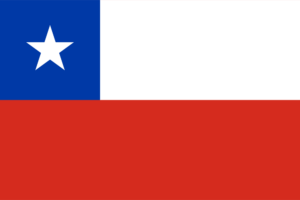
Chile
Indigenous groups inhabited central and southern Chile for several thousand years, living in mixed pastoralist and settled communities. The Inca then ruled the north of the country for nearly a century prior to the arrival of the Spanish in the 16th century.
Location
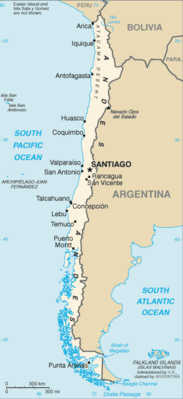
Source: CIA World Factbook (public domain)
Geography
note 1: Chile is the longest country north-to-south in the world, extending across 39 degrees of latitudenote 2: Chile is one of the countries along the Ring of Fire, which is a belt bordering the Pacific Ocean that contains about 75% of the world's volcanoes and up to 90% of the world's earthquakesnote 3: the Atacama Desert in the north of Chile is the driest desert in the world; Ojos del Salado (6,893 m) in the Atacama Desert is the highest active volcano in the world, Chile's tallest mountain, and the second-highest in the Western Hemisphere and the Southern Hemisphere; the volcano's small crater lake is the world's highest lake at 6,390 m
Source: CIA World Factbook (public domain)
History
Indigenous groups inhabited central and southern Chile for several thousand years, living in mixed pastoralist and settled communities. The Inca then ruled the north of the country for nearly a century prior to the arrival of the Spanish in the 16th century. In 1541, the Spanish established the Captaincy General of Chile, which lasted until Chile declared its independence in 1810. The subsequent struggle with the Spanish became tied to other South American independence conflicts, with a decisive victory not being achieved until 1818. In the War of the Pacific (1879-83), Chile defeated Peru and Bolivia to win its current northernmost regions. By the 1880s, the Chilean central government cemented its control over the central and southern regions inhabited by Mapuche Indigenous peoples. Between 1891 and 1973, a series of elected governments succeeded each other until the Marxist government of Salvador ALLENDE was overthrown in 1973 in a military coup led by General Augusto PINOCHET, who ruled until a democratically elected president was inaugurated in 1990. Economic reforms that were maintained consistently since the 1980s contributed to steady growth, reduced poverty rates by over half, and helped secure the country's commitment to democratic and representative government. Chile has increasingly assumed regional and international leadership roles befitting its status as a stable, democratic nation.
Source: CIA World Factbook (public domain)
Government
presidential republic. Independence: 18 September 1810 (from Spain)
Source: CIA World Factbook (public domain)
Economy
export-driven economy; leading copper producer; though hit by COVID-19, fairly quick rebound from increased liquidity and rapid vaccine rollouts; decreasing poverty but still lingering inequality; public debt rising but still manageable; recent political violence has had negative economic consequences
Source: CIA World Factbook (public domain)
Suggested Reading
Adopt This Country
Will you help us keep the Chile page accurate and up to date?
Adopt This Country