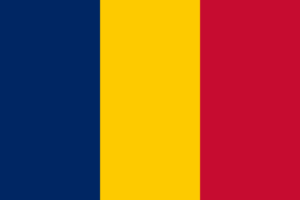
Chad
Chad emerged from a collection of powerful states that controlled the Sahelian belt starting around the 9th century. These states focused on controlling trans-Saharan trade routes and profited mostly from the slave trade.
Location
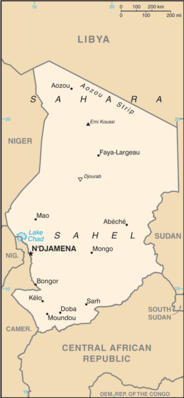
Source: CIA World Factbook (public domain)
Geography
note 1: Chad is the largest of Africa's 16 landlocked countries note 2: a wide variety of animals lived in modern-day Chad during the African Humid Period, including elephants, giraffes, hippos, and antelope; the last remnant of this "Green Sahara" exists in the Lakes of Ounianga in northern Chad, a series of 18 interconnected freshwater, saline, and hypersaline lakes note 3: Lake Chad, the most significant water body in the Sahel, is a remnant of a former inland sea, paleolake Mega-Chad; at its greatest extent, sometime before 5000 B.C., Lake Mega-Chad was the largest of four Saharan paleolakes that existed during the African Humid Period; it covered an area of about 400,000 sq km (150,000 sq mi), roughly the size of today's Caspian Sea
Source: CIA World Factbook (public domain)
History
Chad emerged from a collection of powerful states that controlled the Sahelian belt starting around the 9th century. These states focused on controlling trans-Saharan trade routes and profited mostly from the slave trade. The Kanem-Bornu Empire, centered around the Lake Chad Basin, existed between the 9th and 19th centuries, and at its peak, the empire controlled territory stretching from southern Chad to southern Libya and included portions of modern-day Algeria, Cameroon, Niger, Nigeria, and Sudan. The Sudanese warlord Rabih AZ-ZUBAYR used an army comprised largely of slaves to conquer the Kanem-Bornu Empire in the late 19th century. In southeastern Chad, the Bagirmi and Ouaddai (Wadai) kingdoms emerged in the 15th and 16th centuries and lasted until the arrival of the French in the 19th and 20th centuries. France began moving into the region in the late 1880s and defeated the Bagirmi kingdom in 1897, Rabih AZ-ZUBAYR in 1900, and the Ouddai kingdom in 1909. In the arid regions of northern Chad and southern Libya, an Islamic order called the Sanusiyya (Sanusi) relied heavily on the trans-Saharan slave trade and had upwards of 3 million followers by the 1880s. The French defeated the Sanusiyya in 1910 after years of intermittent war. By 1910, France had incorporated the northern arid region, the Lake Chad Basin, and southeastern Chad into French Equatorial Africa. Chad achieved its independence in 1960 and then saw three decades of instability, oppressive rule, civil war, and a Libyan invasion. With the help of the French military and several African countries, Chadian leaders expelled Libyan forces during the 1987 "Toyota War," so named for the use of Toyota pickup trucks as fighting vehicles. In 1990, Chadian general Idriss DEBY led a rebellion against President Hissene HABRE. Under DEBY, Chad approved a constitution and held elections in 1996. Shortly after DEBY was killed during a rebel incursion in 2021, a group of military officials -- led by DEBY’s son, Mahamat Idriss DEBY -- took control of the government. The military officials dismissed the National Assembly, suspended the Constitution, and formed a Transitional Military Council (TMC), while pledging to hold democratic elections by October 2022. A national dialogue in August-October 2022 culminated in decisions to extend the transition for up to two years, dissolve the TMC, and appoint Mahamat DEBY as Transitional President; the transitional authorities held a constitutional referendum in December 2023 and claimed 86 percent of votes were in favor of the new constitution. The transitional authorities have announced plans to hold elections by October 2024. Chad has faced widespread poverty, an economy severely weakened by volatile international oil prices, terrorist-led insurgencies in the Lake Chad Basin, and several waves of rebellions in northern and eastern Chad. In 2015, the government imposed a state of emergency in the Lake Chad Basin following multiple attacks by the terrorist group Boko Haram, now known as ISIS-West Africa. The same year, Boko Haram conducted bombings in N'Djamena. In 2019, the Chadian government also declared a state of emergency in the Sila and Ouaddai regions bordering Sudan and in the Tibesti region bordering Niger, where rival ethnic groups are still fighting. The army has suffered heavy losses to Islamic terror groups in the Lake Chad Basin.
Source: CIA World Factbook (public domain)
Government
presidential republic. Independence: 11 August 1960 (from France)
Source: CIA World Factbook (public domain)
Economy
oil-dependent economy challenged by market fluctuations, regional instability, refugee influx, and climate vulnerability; high levels of extreme poverty and food insecurity; recent growth driven by oil and agricultural recovery; debt-restructuring agreement under G20 Common Framework
Source: CIA World Factbook (public domain)
Suggested Reading
Adopt This Country
Will you help us keep the Chad page accurate and up to date?
Adopt This Country