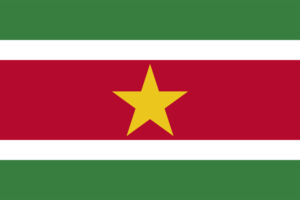
Suriname
The Country of the Week

Quick Facts
- Capital
- Paramaribo
- Population
- 653,605 (2025 est.)
- Area
- 163,820 sq km
- Government
- presidential republic
- Religions
- Protestant 23.6% (includes Evangelical 11.2%, Moravian 11.2%, Reformed 0.7%, Lutheran 0.5%), Hindu 22.3%, Roman Catholic 21.6%, Muslim 13.8%, other Christian 3.2%, Winti 1.8%, Jehovah's Witness 1.2%, other 1.7%, none 7.5%, unspecified 3.2% (2012 est.)
- Ethnic Groups
- Hindustani (also known locally as "East Indians"; their ancestors emigrated from northern India in the latter part of the 19th century) 27.4%, Maroon (their African ancestors were brought to the country in the 17th and 18th centuries as slaves and escaped to the interior) 21.7%, Creole (mixed White and Black) 15.7%, Javanese 13.7%, mixed 13.4%, other 7.6%, unspecified 0.6% (2012 est.)
- Currency
- Surinamese dollars (SRD)
- Life Expectancy
- 72.7 years (2024 est.)
- Internet Domain
- .sr
- Climate
- tropical; moderated by trade winds
- Terrain
- mostly rolling hills; narrow coastal plain with swamps
- Natural Resources
- timber, hydropower, fish, kaolin, shrimp, bauxite, gold, and small amounts of nickel, copper, platinum, iron ore
- Major Exports
- gold, fish, refined petroleum, wood, tobacco (2023)
Source: CIA World Factbook (public domain)
Overview
The Spaniards first explored Suriname in the 16th century, and the English then settled it in the mid-17th century. Suriname became a Dutch colony in 1667. With the abolition of African slavery in 1863, workers were brought in from India and Java.