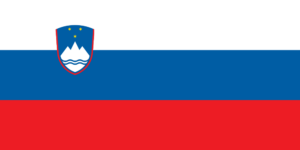
Slovenia
The Slovene lands were part of the Austro-Hungarian Empire until the latter's dissolution at the end of World War I. In 1918, Slovenia became part of the Kingdom of Serbs, Croats, and Slovenes, which was renamed Yugoslavia in 1929.
Location
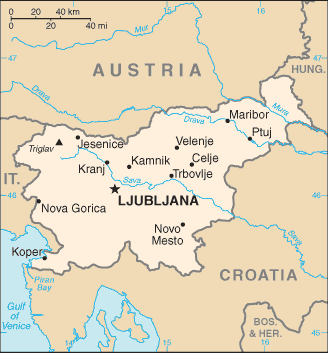
Source: CIA World Factbook (public domain)
Geography
despite its small size, this eastern Alpine country controls some of Europe's major transit routes
Source: CIA World Factbook (public domain)
History
The Slovene lands were part of the Austro-Hungarian Empire until the latter's dissolution at the end of World War I. In 1918, Slovenia became part of the Kingdom of Serbs, Croats, and Slovenes, which was renamed Yugoslavia in 1929. After World War II, Slovenia joined Bosnia and Herzegovina, Croatia, Macedonia, Montenegro, and Serbia as one of the constituent republics in the new Socialist Federal Republic of Yugoslavia (SFRY). In 1990, Slovenia held its first multiparty elections, as well as a referendum on independence. Serbia responded with an economic blockade and military action, but after a short 10-day war, Slovenia declared independence in 1991. Slovenia acceded to both NATO and the EU in the spring of 2004; it joined the euro zone and the Schengen Area in 2007.
Source: CIA World Factbook (public domain)
Government
parliamentary republic. Independence: 25 June 1991 (from Yugoslavia)
Source: CIA World Factbook (public domain)
Economy
high-income EU and eurozone economy; high per-capita income and low inequality; key exports in automotive and pharmaceuticals; tight labor market with low unemployment; growth supported by private consumption and public investment, with risks from tight labor market and trade conditions; narrowing fiscal deficit and declining public debt
Source: CIA World Factbook (public domain)
Suggested Reading
Adopt This Country
Will you help us keep the Slovenia page accurate and up to date?
Adopt This Country