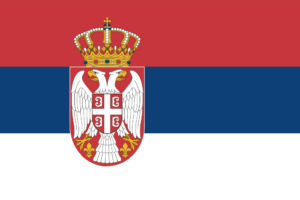
Serbia
In 1918, the Croats, Serbs, and Slovenes formed a kingdom known after 1929 as Yugoslavia. The monarchy remained in power until 1945, when the communist Partisans headed by Josip Broz (aka TITO) took control of the newly created Socialist Federal Republic of Yugoslavia (SFRY).
Location
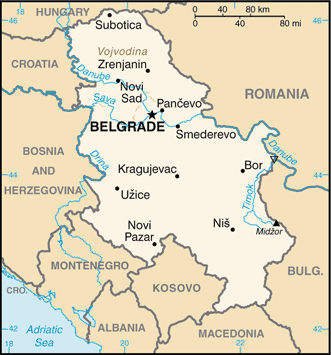
Source: CIA World Factbook (public domain)
Geography
landlocked; controls one of the major land routes from Western Europe to Turkey and the Near East
Source: CIA World Factbook (public domain)
History
In 1918, the Croats, Serbs, and Slovenes formed a kingdom known after 1929 as Yugoslavia. The monarchy remained in power until 1945, when the communist Partisans headed by Josip Broz (aka TITO) took control of the newly created Socialist Federal Republic of Yugoslavia (SFRY). After TITO died in 1980, communism in Yugoslavia gradually gave way to resurgent nationalism. In 1989, Slobodan MILOSEVIC became president of the Republic of Serbia, and his calls for Serbian domination led to the violent breakup of Yugoslavia along ethnic lines. In 1991, Croatia, Slovenia, and Macedonia declared independence, followed by Bosnia in 1992. The remaining republics of Serbia and Montenegro declared a new Federal Republic of Yugoslavia (FRY) in 1992, and MILOSEVIC led military campaigns to unite ethnic Serbs in neighboring republics into a "Greater Serbia." These actions ultimately failed, and international intervention led to the signing of the Dayton Accords in 1995. In 1998, an ethnic Albanian insurgency in the formerly autonomous Serbian province of Kosovo resulted in a brutal Serbian counterinsurgency campaign. Serbia rejected a proposed international settlement, and NATO responded with a bombing campaign that forced Serbian forces to withdraw from Kosovo in June 1999. In 2003, the FRY became the State Union of Serbia and Montenegro, a loose federation of the two republics. In 2006, Montenegro seceded and declared itself an independent nation. In 2008, Kosovo also declared independence -- an action Serbia still refuses to recognize. In 2013, Serbia and Kosovo signed the first agreement of principles governing the normalization of relations between the two countries. Additional agreements were reached in 2015 and 2023, but implementation remains incomplete. Serbia has been an official candidate for EU membership since 2012, and President Aleksandar VUCIC has promoted the ambitious goal of Serbia joining the EU by 2025.
Source: CIA World Factbook (public domain)
Government
parliamentary republic. Independence: 5 June 2006 (from the State Union of Serbia and Montenegro); notable earlier dates: 1217 (Serbian Kingdom established); 16 April 1346 (Serbian Empire established); 13 July 1878 (Congress of Berlin recognizes Serbian independence); 1 December 1918 (Kingdom of Serbs, Croats, and Slovenes established, later known as Yugoslavia)
Source: CIA World Factbook (public domain)
Economy
upper middle-income Balkan economy; current EU accession candidate; hit by COVID-19; pursuing green growth development; manageable public debt; new anticorruption efforts; falling unemployment; historic Russian relations; energy import-dependent
Source: CIA World Factbook (public domain)
Suggested Reading
Adopt This Country
Will you help us keep the Serbia page accurate and up to date?
Adopt This Country