Romania
The principalities of Wallachia and Moldavia -- for centuries under the control of the Turkish Ottoman Empire -- secured their autonomy through the Treaty of Paris in 1856. They were de facto linked in 1859 and formally united in 1862 under the new name of Romania.
Location
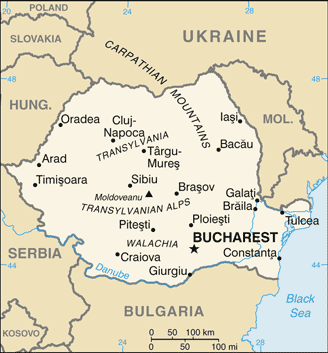
Source: CIA World Factbook (public domain)
Geography
controls the most easily traversable land route between the Balkans, Moldova, and Ukraine; the Carpathian Mountains dominate the center of the country, and the Danube River forms much of the southern boundary with Serbia and Bulgaria
Source: CIA World Factbook (public domain)
History
The principalities of Wallachia and Moldavia -- for centuries under the control of the Turkish Ottoman Empire -- secured their autonomy through the Treaty of Paris in 1856. They were de facto linked in 1859 and formally united in 1862 under the new name of Romania. The country joined the Allied Powers in World War I and subsequently acquired new territories -- most notably Transylvania -- that more than doubled its size. In 1940, Romania allied with the Axis powers and participated in the 1941 German invasion of the USSR. Three years later, overrun by the Soviets, Romania signed an armistice. The post-war Soviet occupation led to the formation of a communist "people's republic" in 1947 and the abdication of the king. The decades-long rule of dictator Nicolae CEAUSESCU, who took power in 1965, and his Securitate police state became increasingly oppressive and draconian through the 1980s. CEAUSESCU was overthrown and executed in late 1989. Former communists dominated the government until 1996 when they were swept from power. Romania joined NATO in 2004, the EU in 2007, and the Schengen Area for air and sea travel in 2024.
Source: CIA World Factbook (public domain)
Government
semi-presidential republic. Independence: 9 May 1877 (independence proclaimed from the Ottoman Empire; 13 July 1878 (independence recognized by the Treaty of Berlin); 26 March 1881 (kingdom proclaimed); 30 December 1947 (republic proclaimed)
Source: CIA World Factbook (public domain)
Economy
high-income, EU-member economy; euro membership delayed over macroeconomic indicators; persistent inflation, but consumption and EU-funded investments driving recovery; skilled labor shortage; high public debt and budget deficit; challenges include fiscal sustainability and political instability
Source: CIA World Factbook (public domain)
Suggested Reading
Adopt This Country
Will you help us keep the Romania page accurate and up to date?
Adopt This Country