
Qatar
Ruled by the Al Thani family since the mid-1800s, Qatar within the last 60 years transformed itself from a poor British protectorate noted mainly for pearling into an independent state with significant hydrocarbon revenues.
Location
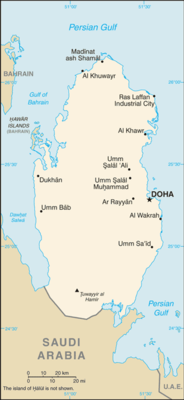
Source: CIA World Factbook (public domain)
Geography
the peninsula occupies a strategic location in the central Persian Gulf near major petroleum deposits
Source: CIA World Factbook (public domain)
History
Ruled by the Al Thani family since the mid-1800s, Qatar within the last 60 years transformed itself from a poor British protectorate noted mainly for pearling into an independent state with significant hydrocarbon revenues. Former Amir HAMAD bin Khalifa Al Thani, who overthrew his father in a bloodless coup in 1995, ushered in wide-sweeping political and media reforms, unprecedented economic investment, and a growing Qatari regional leadership role, in part through the creation of the pan-Arab satellite news network Al-Jazeera and Qatar's mediation of some regional conflicts. In the 2000s, Qatar resolved its longstanding border disputes with both Bahrain and Saudi Arabia, and by 2007, Doha had attained the highest per capita income in the world. Qatar did not experience domestic unrest or violence like that seen in other Near Eastern and North African countries in 2011, due in part to its immense wealth and patronage network. In mid-2013, HAMAD peacefully abdicated, transferring power to his son, the current Amir TAMIM bin Hamad. TAMIM is popular with the Qatari public for his role in shepherding the country through an economic embargo from some other regional countries, for his efforts to improve the country's healthcare and education systems, and for his expansion of the country's infrastructure in anticipation of hosting international sporting events. Qatar became the first country in the Arab world to host the FIFA Men’s World Cup in 2022. Following the outbreak of regional unrest in 2011, Doha prided itself on its support for many popular revolutions, particularly in Libya and Syria. This stance was to the detriment of Qatar’s relations with Bahrain, Egypt, Saudi Arabia, and the United Arab Emirates (UAE), which temporarily recalled their respective ambassadors from Doha in 2014. TAMIM later oversaw a warming of Qatar’s relations with Bahrain, Egypt, Saudi Arabia, and the UAE in November 2014 following Kuwaiti mediation and signing of the Riyadh Agreement. This reconciliation, however, was short-lived. In 2017, Bahrain, Egypt, Saudi Arabia, and the UAE (the "Quartet") cut diplomatic and economic ties with Qatar in response to alleged violations of the agreement, among other complaints. They restored ties in 2021 after signing a declaration at the Gulf Cooperation Council Summit in Al Ula, Saudi Arabia. In 2022, the United States designated Qatar as a major non-NATO ally.
Source: CIA World Factbook (public domain)
Government
absolute monarchy. Independence: 3 September 1971 (from the UK)
Source: CIA World Factbook (public domain)
Economy
high-income, oil-and-gas-based Middle Eastern economy; implementing “National Vision 2030” government strategy for economic development, diversification, and favorable business conditions to boost investment and employment; expansion of LNG sector expected to boost growth; Islamic finance leader
Source: CIA World Factbook (public domain)
Suggested Reading
Adopt This Country
Will you help us keep the Qatar page accurate and up to date?
Adopt This Country