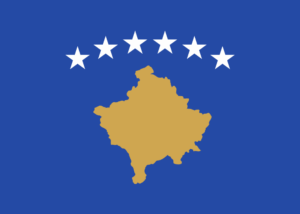
Kosovo
The Ottoman Empire took control of Kosovo in 1389 after defeating Serbian forces. Large numbers of Turks and Albanians moved to the region, and by the end of the 19th century, Albanians had replaced Serbs as the majority ethnic group in Kosovo.
Location

Source: CIA World Factbook (public domain)
Geography
the 41-km (25-mi) Nerodimka River divides into two branches, each of which flows into a different sea: the northern branch flows into the Sitnica River, which via the Ibar, Morava, and Danube Rivers ultimately flows into the Black Sea; the southern branch flows via the Lepenac and Vardar Rivers into the Aegean Sea
Source: CIA World Factbook (public domain)
History
The Ottoman Empire took control of Kosovo in 1389 after defeating Serbian forces. Large numbers of Turks and Albanians moved to the region, and by the end of the 19th century, Albanians had replaced Serbs as the majority ethnic group in Kosovo. Serbia reacquired control of Kosovo during the First Balkan War of 1912, and after World War II, Kosovo became an autonomous province of Serbia in the Socialist Federal Republic of Yugoslavia (SFRY). Increasing Albanian nationalism in the 1980s led to riots and calls for Kosovo's independence, but in 1989, Belgrade -- which has in turn served as the capital of Serbia and Yugoslavia -- revoked Kosovo's autonomous status. When the SFRY broke up in 1991, Kosovo Albanian leaders organized an independence referendum, and Belgrade's repressive response led to an insurgency. Kosovo remained part of Serbia, which joined with Montenegro to declare a new Federal Republic of Yugoslavia (FRY) in 1992. In 1998, Belgrade launched a brutal counterinsurgency campaign, with some 800,000 ethnic Albanians expelled from their homes in Kosovo. After international mediation failed, a NATO military operation began in March 1999 and forced Belgrade to withdraw its forces from Kosovo. UN Security Council Resolution 1244 (1999) placed Kosovo under the temporary control of the UN Interim Administration Mission in Kosovo (UNMIK). Negotiations in 2006-07 ended without agreement between Serbia and Kosovo, though the UN issued a comprehensive report that endorsed independence. On 17 February 2008, the Kosovo Assembly declared Kosovo independent. Serbia continues to reject Kosovo's independence, but the two countries began EU-facilitated discussions in 2013 to normalize relations, which resulted in several agreements. Additional agreements were reached in 2015 and 2023, but implementation remains incomplete. In 2022, Kosovo formally applied for membership in the EU, which is contingent on fulfillment of accession criteria, and the Council of Europe. Kosovo is also seeking UN and NATO memberships.
Source: CIA World Factbook (public domain)
Government
parliamentary republic. Independence: 17 February 2008 (from Serbia)
Source: CIA World Factbook (public domain)
Economy
small-but-growing European economy; non-EU member but unilateral euro user; very high unemployment, especially youth; vulnerable reliance on diaspora tourism services, curtailed by COVID-19 disruptions; unclear public loan portfolio health
Source: CIA World Factbook (public domain)
Suggested Reading
Adopt This Country
Will you help us keep the Kosovo page accurate and up to date?
Adopt This Country