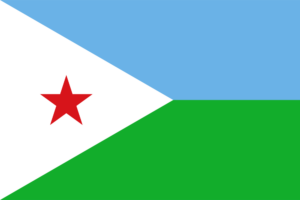
Djibouti
Present-day Djibouti was the site of the medieval Ifat and Adal Sultanates. In the late 19th century, the Afar sultans signed treaties with the French that allowed the latter to establish the colony of French Somaliland in 1862.
Location
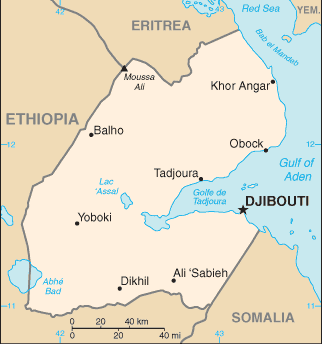
Source: CIA World Factbook (public domain)
Geography
strategic location near world's busiest shipping lanes and close to Arabian oilfields; Lac Assal (Lake Assal) is the lowest point in Africa and the saltiest lake in the world
Source: CIA World Factbook (public domain)
History
Present-day Djibouti was the site of the medieval Ifat and Adal Sultanates. In the late 19th century, the Afar sultans signed treaties with the French that allowed the latter to establish the colony of French Somaliland in 1862. The French signed additional treaties with the ethnic Somali in 1885. Tension between the ethnic Afar and Somali populations increased over time, as the ethnic Somalis perceived that the French unfairly favored the Afar and gave them disproportionate influence in local governance. In 1958, the French held a referendum that provided residents of French Somaliland the option to either continue their association with France or to join neighboring Somalia as it established its independence. Ethnic Somali protested the vote, because French colonial leaders did not recognize many Somali as residents, which gave the Afar outsized influence in the decision to uphold ties with France. After a second referendum in 1967, the French changed the territory’s name to the French Territory of the Afars and the Issas, in part to underscore their relationship with the ethnic Afar and downplay the significance of the ethnic Somalis. A final referendum in 1977 established Djibouti as an independent nation and granted ethnic Somalis Djiboutian nationality, formally resetting the balance of power between the majority ethnic Somalis and minority ethnic Afar residents. Upon independence, the country was named after its capital city of Djibouti. Hassan Gouled APTIDON, an ethnic Somali leader, installed an authoritarian one-party state and served as president until 1999. Unrest between the Afar minority and Somali majority culminated in a civil war during the 1990s that ended in 2001 with a peace accord between Afar rebels and the Somali Issa-dominated government. In 1999, Djibouti's first multiparty presidential election resulted in the election of Ismail Omar GUELLEH as president; he was reelected to a second term in 2005 and extended his tenure in office via a constitutional amendment, which allowed him to serve his third and fourth terms, and to begin a fifth term in 2021. Djibouti occupies a strategic geographic location at the intersection of the Red Sea and the Gulf of Aden. Its ports handle 95% of Ethiopia’s trade. Djibouti’s ports also service transshipments between Europe, the Middle East, and Asia. The government has longstanding ties to France, which maintains a military presence in the country, as do the US, Japan, Italy, Germany, Spain, and China.
Source: CIA World Factbook (public domain)
Government
presidential republic. Independence: 27 June 1977 (from France)
Source: CIA World Factbook (public domain)
Economy
food import-dependent Horn of Africa economy driven by various national military bases and port-based trade; fairly resilient from COVID-19 disruptions; major re-exporter; increasing Ethiopian and Chinese trade relations; investing in infrastructure
Source: CIA World Factbook (public domain)
Suggested Reading
Adopt This Country
Will you help us keep the Djibouti page accurate and up to date?
Adopt This Country