Zambia
Bantu-speaking groups mainly from the Luba and Lunda Kingdoms in the Congo River Basin and from the Great Lakes region in East Africa settled in what is now Zambia beginning around A.D. 300, displacing and mixing with previous population groups in the region.
Location
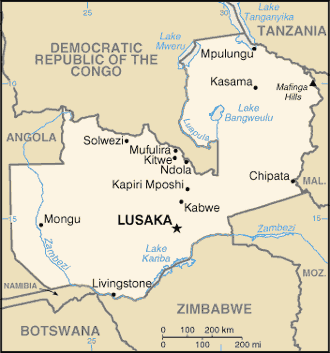
Source: CIA World Factbook (public domain)
Geography
landlocked; the Zambezi forms a natural river boundary with Zimbabwe; Lake Kariba on the Zambia-Zimbabwe border forms the world's largest reservoir by volume (180 cu km; 43 cu mi)
Source: CIA World Factbook (public domain)
History
Bantu-speaking groups mainly from the Luba and Lunda Kingdoms in the Congo River Basin and from the Great Lakes region in East Africa settled in what is now Zambia beginning around A.D. 300, displacing and mixing with previous population groups in the region. The Mutapa Empire developed after the fall of Great Zimbabwe to the south in the 14th century and ruled the region, including large parts of Zambia, from the 14th to 17th century. The empire collapsed as a result of the growing slave trade and Portuguese incursions in the 16th and 17th centuries. The region was further influenced by migrants from the Zulu Kingdom to the south and the Luba and Lunda Kingdoms to the north, after invading colonial and African powers displaced local residents into the area around the Zambezi River, in what is now Zambia. In the 1880s, British companies began securing mineral and other economic concessions from local leaders. The companies eventually claimed control of the region and incorporated it as the protectorate of Northern Rhodesia in 1911. The UK took over administrative control from the British South Africa Company in 1924. During the 1920s and 1930s, advances in mining spurred British economic ventures and colonial settlement. Northern Rhodesia’s name was changed to Zambia upon independence from the UK in 1964, under independence leader and first President Kenneth KAUNDA. In the 1980s and 1990s, declining copper prices, economic mismanagement, and a prolonged drought hurt the economy. Elections in 1991 brought an end to one-party rule and propelled the Movement for Multiparty Democracy (MMD) into power. The subsequent vote in 1996, however, saw increasing harassment of opposition parties and abuse of state media and other resources. Administrative problems marked the election in 2001, with three parties filing a legal petition challenging the election of ruling party candidate Levy MWANAWASA. MWANAWASA was reelected in 2006 in an election that was deemed free and fair. Upon his death in 2008, he was succeeded by his vice president, Rupiah BANDA, who won a special presidential byelection later that year. BANDA and the MMD lost to Michael SATA and the Patriotic Front (PF) in the 2011 general elections. SATA, however, presided over a period of haphazard economic management and attempted to silence opposition to PF policies. SATA died in 2014 and was succeeded by his vice president, Guy SCOTT, who served as interim president until 2015, when Edgar LUNGU won the presidential byelection and completed SATA's term. LUNGU then won a full term in the 2016 presidential elections. Hakainde HICHILEMA was elected president in 2021.
Source: CIA World Factbook (public domain)
Government
presidential republic. Independence: 24 October 1964 (from the UK)
Source: CIA World Factbook (public domain)
Economy
lower-middle-income sub-Saharan economy; regional hydroelectricity producer; trade ties and infrastructure investments from China; IMF assistance to restructure debt burden; one of youngest and fastest-growing labor forces; systemic corruption; extreme rural poverty
Source: CIA World Factbook (public domain)
Suggested Reading
Adopt This Country
Will you help us keep the Zambia page accurate and up to date?
Adopt This Country