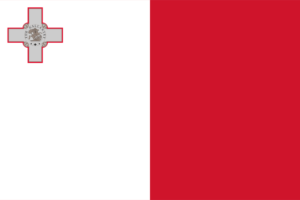
Malta
With a civilization that dates back thousands of years, Malta boasts some of the oldest megalithic sites in the world.
Location
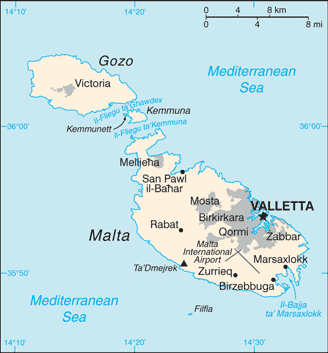
Source: CIA World Factbook (public domain)
Geography
the country is an archipelago, with only the three largest islands (Malta, Ghawdex or Gozo, and Kemmuna or Comino) inhabited; numerous bays provide good harbors
Source: CIA World Factbook (public domain)
History
With a civilization that dates back thousands of years, Malta boasts some of the oldest megalithic sites in the world. Situated in the center of the Mediterranean, Malta’s islands have long served as a strategic military asset, with the islands at various times falling under the control of the Phoenicians, Carthaginians, Greeks, Romans, Byzantines, Moors, Normans, Sicilians, Spanish, Knights of St. John, and French. Most recently a British colony (since 1814), Malta gained its independence in 1964 and declared itself a republic 10 years later. While under British rule, the island staunchly supported the UK through both world wars. Since the mid-1980s, the island has transformed itself into a freight transshipment point, a financial center, and a tourist destination, as its key industries moved toward more service-oriented activities. Malta became an EU member in 2004 and joined the eurozone in 2008.
Source: CIA World Factbook (public domain)
Government
parliamentary republic. Independence: 21 September 1964 (from the UK)
Source: CIA World Factbook (public domain)
Economy
high-income, EU-member European economy; diversified portfolio; euro user; dependent on food and energy imports; strong tourism, trade, and manufacturing sectors; high North African immigration; large welfare system; educated workforce
Source: CIA World Factbook (public domain)
Suggested Reading
Adopt This Country
Will you help us keep the Malta page accurate and up to date?
Adopt This Country