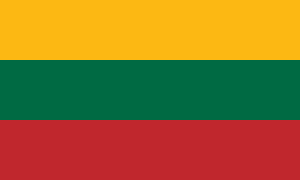
Lithuania
Lithuanian lands were united under MINDAUGAS in 1236; over the next century, Lithuania extended its territory through alliances and conquest to include most of present-day Belarus and Ukraine. By the end of the 14th century, Lithuania was the largest state in Europe.
Location
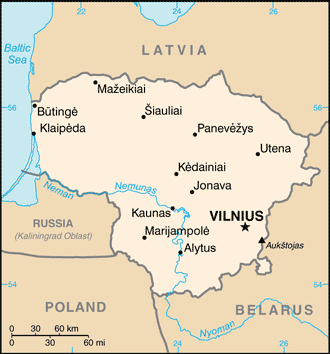
Source: CIA World Factbook (public domain)
Geography
fertile central plains are separated by hilly uplands that are ancient glacial deposits
Source: CIA World Factbook (public domain)
History
Lithuanian lands were united under MINDAUGAS in 1236; over the next century, Lithuania extended its territory through alliances and conquest to include most of present-day Belarus and Ukraine. By the end of the 14th century, Lithuania was the largest state in Europe. An alliance with Poland in 1386 led the two countries into a union through a common ruler. In 1569, Lithuania and Poland formally united into a single dual state, the Polish-Lithuanian Commonwealth. This entity survived until 1795 when surrounding countries partitioned its remnants. Lithuania regained its independence after World War I, but the USSR annexed it in 1940 -- an action never recognized by the US and many other countries. In 1990, Lithuania became the first of the Soviet republics to declare its independence, but Moscow did not recognize this proclamation until 1991. The last Russian troops withdrew in 1993. Lithuania subsequently restructured its economy for integration into West European institutions; it joined both NATO and the EU in 2004. In 2015, Lithuania joined the euro zone, and it joined the Organization for Economic Cooperation and Development in 2018.
Source: CIA World Factbook (public domain)
Government
semi-presidential republic. Independence: 16 February 1918 (from Soviet Russia and Germany); 11 March 1990 (declared from the Soviet Union); 6 September 1991 (recognized by the Soviet Union); notable earlier dates: 6 July 1253 (coronation of MINDAUGAS, traditional founding date); 1 July 1569 (Polish-Lithuanian Commonwealth created)
Source: CIA World Factbook (public domain)
Economy
high-income EU and eurozone member, largest Baltic economy; recovery supported by private consumption and EU fund-driven investments; structural challenges include pension reform, aging workforce, and high energy-import costs
Source: CIA World Factbook (public domain)
Suggested Reading
Adopt This Country
Will you help us keep the Lithuania page accurate and up to date?
Adopt This Country