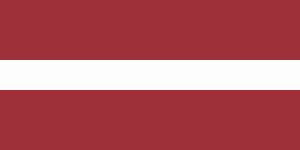
Latvia
Several eastern Baltic tribes merged in medieval times to form the ethnic core of the Latvian people (ca. 8th-12th centuries A.D.). The region subsequently came under the control of Germans, Poles, Swedes, and finally Russians.
Location
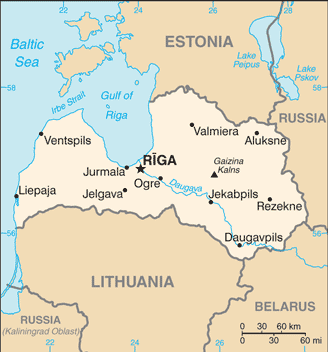
Source: CIA World Factbook (public domain)
Geography
most of the country is composed of fertile low-lying plains with some hills in the east
Source: CIA World Factbook (public domain)
History
Several eastern Baltic tribes merged in medieval times to form the ethnic core of the Latvian people (ca. 8th-12th centuries A.D.). The region subsequently came under the control of Germans, Poles, Swedes, and finally Russians. A Latvian republic emerged following World War I, but the USSR annexed it in 1940 -- an action never recognized by the US and many other countries. Latvia reestablished its independence in 1991 after the breakup of the Soviet Union. Although the last Russian troops left in 1994, the status of the Russian minority (some 25% of the population) remains of concern to Moscow. Latvia joined both NATO and the EU in 2004; it joined the euro zone in 2014 and the OECD in 2016.
Source: CIA World Factbook (public domain)
Government
parliamentary republic. Independence: 18 November 1918 (from Soviet Russia); 4 May 1990 (declared from the Soviet Union); 6 September 1991 (recognized by the Soviet Union)
Source: CIA World Factbook (public domain)
Economy
high-income EU and eurozone member; weak recovery following economic contraction, with slight increase in private consumption and uncertain trade environment; challenges from skilled-labor shortages, capital market access, large informal sector, and green and digital transitions
Source: CIA World Factbook (public domain)
Suggested Reading
Adopt This Country
Will you help us keep the Latvia page accurate and up to date?
Adopt This Country