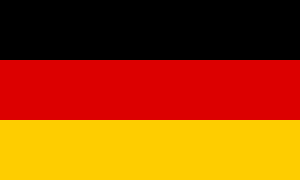
Germany
As Europe's largest economy and second most-populous nation (after Russia), Germany is a key member of the continent's economic, political, and defense organizations.
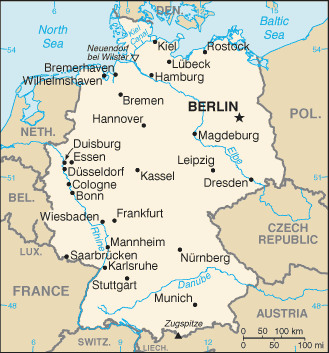
Location
Source: CIA World Factbook (public domain)
Geography
strategic location on North European Plain and along the entrance to the Baltic Sea; most major rivers in Germany -- the Rhine, Weser, Oder, Elbe -- flow northward; the Danube, which originates in the Black Forest, flows eastward
Source: CIA World Factbook (public domain)
History
As Europe's largest economy and second most-populous nation (after Russia), Germany is a key member of the continent's economic, political, and defense organizations. European power struggles immersed Germany in two devastating world wars in the first half of the 20th century and left the country occupied by the victorious Allied powers of the US, UK, France, and the Soviet Union in 1945. With the advent of the Cold War, two German states were formed in 1949: the western Federal Republic of Germany (FRG) and the eastern German Democratic Republic (GDR). The democratic FRG embedded itself in key western economic and security organizations, including the EC (now the EU) and NATO, while the communist GDR was on the front line of the Soviet-led Warsaw Pact. The decline of the Soviet Union and the end of the Cold War allowed German reunification to occur in 1990. Since then, Germany has expended considerable funds to bring eastern productivity and wages up to western standards. In January 1999, Germany and 10 other EU countries introduced a common European exchange currency, the euro.
Source: CIA World Factbook (public domain)
Government
federal parliamentary republic. Independence: 18 January 1871 (establishment of the German Empire); divided into four zones of occupation (UK, US, USSR, and France) in 1945 after World War II; Federal Republic of Germany (FRG or West Germany) proclaimed on 23 May 1949 and included the former UK, US, and French zones; German Democratic Republic (GDR or East Germany) proclaimed on 7 October 1949 and included the former USSR zone; West Germany and East Germany unified on 3 October 1990, with all four powers formally relinquishing rights on 15 March 1991; notable earlier dates: 10 August 843 (Eastern Francia established from the division of the Carolingian Empire); 2 February 962 (crowning of OTTO I, recognized as the first Holy Roman Emperor)
Source: CIA World Factbook (public domain)
Economy
leading export-driven, core EU and eurozone economy; key automotive, chemical, engineering, finance, and green energy industries; growth stalled by energy crisis and declining exports; tight labor market with falling working-age population; fiscal rebalancing with phaseout of energy price supports
Source: CIA World Factbook (public domain)
Suggested Reading
Adopt This Country
Will you help us keep the Germany page accurate and up to date?
Adopt This Country