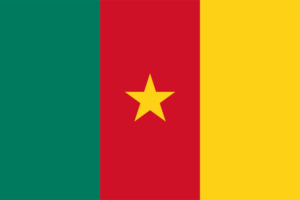
Cameroon
Powerful chiefdoms ruled much of the area of present-day Cameroon before it became a German colony known as Kamerun in 1884. After World War I, the territory was divided between France and the UK as League of Nations mandates.
Location
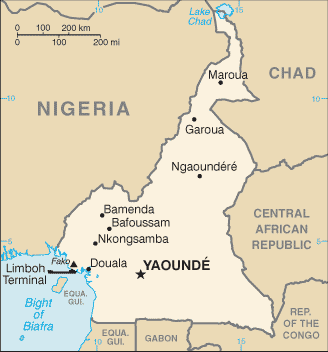
Source: CIA World Factbook (public domain)
Geography
sometimes referred to as the hinge of Africa because of its central location on the continent and its position at the west-south juncture of the Gulf of Guinea; areas of thermal springs and indications of current or prior volcanic activity; Mount Cameroon, the highest mountain in Sub-Saharan west Africa, is an active volcano
Source: CIA World Factbook (public domain)
History
Powerful chiefdoms ruled much of the area of present-day Cameroon before it became a German colony known as Kamerun in 1884. After World War I, the territory was divided between France and the UK as League of Nations mandates. French Cameroon became independent in 1960 as the Republic of Cameroon. The following year, the southern portion of neighboring British Cameroon voted to merge with the new country to form the Federal Republic of Cameroon. In 1972, a new constitution replaced the federation with a unitary state, the United Republic of Cameroon. The country has generally enjoyed stability, which has enabled the development of agriculture, roads, and railways, as well as a petroleum industry. Nonetheless, unrest and violence in the country's two western, English-speaking regions have persisted since 2016. Movement toward democratic reform is slow, and political power remains firmly in the hands of President Paul BIYA.
Source: CIA World Factbook (public domain)
Government
presidential republic. Independence: 1 January 1960 (from French-administered UN trusteeship)
Source: CIA World Factbook (public domain)
Economy
largest CEMAC economy with many natural resources; recent political instability and terrorism reducing economic output; systemic corruption; poor property rights enforcement; increasing poverty in northern regions
Source: CIA World Factbook (public domain)
Suggested Reading
Adopt This Country
Will you help us keep the Cameroon page accurate and up to date?
Adopt This Country