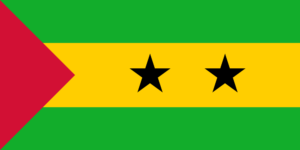
Sao Tome and Principe
Portugal discovered and colonized the uninhabited Sao Tome and Principe islands in the late 15th century, setting up a sugar-based economy that gave way to coffee and cocoa in the 19th century -- all grown with African slave labor, a form of which lingered into the 20th century.
Location
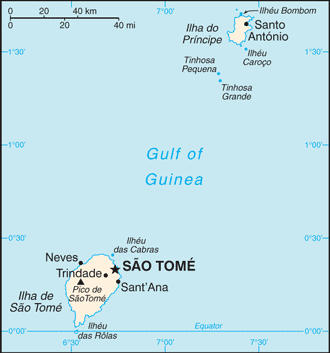
Source: CIA World Factbook (public domain)
Geography
the second-smallest African country (after the Seychelles); the two main islands form part of a chain of extinct volcanoes, and both are mountainous
Source: CIA World Factbook (public domain)
History
Portugal discovered and colonized the uninhabited Sao Tome and Principe islands in the late 15th century, setting up a sugar-based economy that gave way to coffee and cocoa in the 19th century -- all grown with African slave labor, a form of which lingered into the 20th century. While independence was achieved in 1975, democratic reforms were not instituted until the late 1980s. The country held its first free elections in 1991, but frequent internal wrangling among the various political parties precipitated repeated changes in leadership and failed, non-violent coup attempts in 1995, 1998, 2003, and 2009. In 2012, three opposition parties combined in a no-confidence vote to bring down the majority government of former Prime Minister Patrice TROVOADA, but legislative elections returned him to the office two years later. President Evaristo CARVALHO, of the same political party as TROVOADA, was elected in 2016, marking a rare instance in which the same party held the positions of president and prime minister. TROVOADA resigned in 2018 and was replaced by Jorge BOM JESUS. Carlos Vila NOVA was elected president in 2021. TROVOADA began his fourth stint as prime minister in 2022, after his party's victory in legislative elections.
Source: CIA World Factbook (public domain)
Government
semi-presidential republic. Independence: 12 July 1975 (from Portugal)
Source: CIA World Factbook (public domain)
Economy
lower middle-income Central African island economy; falling cocoa production due to drought and mismanagement; joint oil venture with Nigeria; government owns 90% of land; high debt, partly from fuel subsidies; tourism gutted by COVID-19
Source: CIA World Factbook (public domain)
Suggested Reading
Adopt This Country
Will you help us keep the Sao Tome and Principe page accurate and up to date?
Adopt This Country