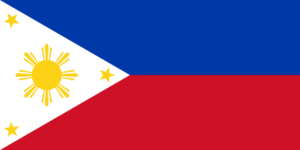
Philippines
The Philippine Islands became a Spanish colony during the 16th century; they were ceded to the US in 1898 following the Spanish-American War. Led by Emilio AGUINALDO, the Filipinos conducted an insurgency against US rule from 1899-1902, although some fighting continued in…
Location
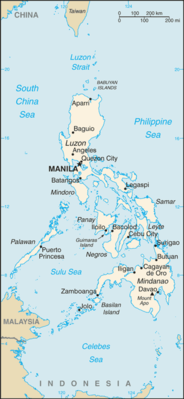
Source: CIA World Factbook (public domain)
Geography
note 1: for decades, the Philippine archipelago was reported as having 7,107 islands; in 2016, the national mapping authority reported that hundreds of new islands had been discovered and increased the number of islands to 7,641, though not all of the new islands have been verifiednote 2: the Philippines is one of the countries along the Ring of Fire, which is a belt bordering the Pacific Ocean that contains about 75% of the world's volcanoes and up to 90% of the world's earthquakesnote 3: the Philippines sits on the Pacific typhoon belt, and an average of 9 typhoons make landfall on the islands each year, with about 5 being destructive; the country is the most exposed in the world to tropical storms
Source: CIA World Factbook (public domain)
History
The Philippine Islands became a Spanish colony during the 16th century; they were ceded to the US in 1898 following the Spanish-American War. Led by Emilio AGUINALDO, the Filipinos conducted an insurgency against US rule from 1899-1902, although some fighting continued in outlying islands as late as 1913. In 1935, the Philippines became a self-governing commonwealth. Manuel QUEZON was elected president and was tasked with preparing the country for independence after a 10-year transition. The islands fell under Japanese occupation during World War II, and US forces and Filipinos fought together during 1944-45 to regain control. On 4 July 1946 the Republic of the Philippines attained its independence. Twenty-one years of authoritarian rule under Ferdinand MARCOS ended in 1986, when a "people power" movement in Manila ("EDSA 1") forced him into exile and installed Corazon AQUINO as president. Several coup attempts hampered her presidency, and progress on political stability and economic development faltered until Fidel RAMOS was elected president in 1992. The US closed its last military bases on the islands the same year. Joseph ESTRADA was elected president in 1998. His vice-president, Gloria MACAPAGAL-ARROYO, succeded him in 2001 after ESTRADA's stormy impeachment trial on corruption charges broke down and another "people power" movement ("EDSA 2") demanded his resignation. MACAPAGAL-ARROYO was elected president in 2004. Corruption allegations marred her presidency, but the Philippine economy was one of the few to avoid contraction after the 2008 global financial crisis. Benigno AQUINO III was elected as president in 2010, followed by Rodrigo DUTERTE in 2016. During his term, DUTERTE pursued a controversial drug war that garnered international criticism for alleged human rights abuses. Ferdinand MARCOS, Jr. was elected president in 2022 with the largest popular vote in a presidential election since his father's ouster.For decades, the country has been challenged by armed ethnic separatists, communist rebels, and Islamic terrorist groups, particularly in the southern islands and remote areas of Luzon.
Source: CIA World Factbook (public domain)
Government
presidential republic. Independence: 4 July 1946 (from the US)
Source: CIA World Factbook (public domain)
Economy
growing Southeast Asian economy; commercial rebound led by transportation, construction and financial services; electronics exports recovering from sector slowdown; significant remittances; interest rate rises following heightened inflation; uncertainties due to increased regional tensions with China
Source: CIA World Factbook (public domain)
Suggested Reading
Adopt This Country
Will you help us keep the Philippines page accurate and up to date?
Adopt This Country