Nigeria
In ancient and pre-colonial times, the area of present-day Nigeria was occupied by a variety of ethnic groups with different languages and traditions.
Location
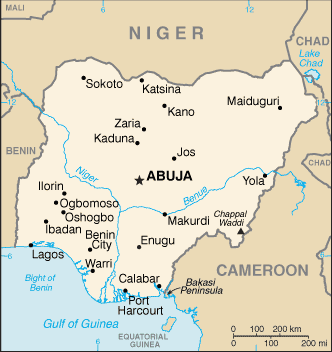
Source: CIA World Factbook (public domain)
Geography
the Niger River enters the country in the northwest and flows southward through tropical rainforests and swamps to its delta in the Gulf of Guinea
Source: CIA World Factbook (public domain)
History
In ancient and pre-colonial times, the area of present-day Nigeria was occupied by a variety of ethnic groups with different languages and traditions. These included large Islamic kingdoms such as Borno, Kano, and the Sokoto Caliphate dominating the north, the Benin and Oyo Empires that controlled much of modern western Nigeria, and more decentralized political entities and city states in the south and southeast. In 1914, the British amalgamated their separately administered northern and southern territories into a Colony and Protectorate of Nigeria. Nigeria achieved independence from Britain in 1960 and transitioned to a federal republic with three constituent states in 1963 under President Nnamdi AZIKIWE. This structure served to enflame regional and ethnic tension, contributing to a bloody coup led by predominately southeastern military officers in 1966 and a countercoup later that year masterminded by northern officers. In the aftermath of this tension, the governor of Nigeria’s Eastern Region, centered on the southeast, declared the region independent as the Republic of Biafra. The ensuring civil war (1967-1970), resulted in more than a million deaths, many from starvation. While the war forged a stronger Nigerian state and national identity, it contributed to long-lasting mistrust of the southeast’s predominantly Igbo population. Wartime military leader Yakubu GOWON ruled until a bloodless coup by frustrated junior officers in 1975. This generation of officers, including Olusegun OBASANJO, Ibrahim BABANGIDA, and Muhammadu BUHARI, who would all later serve as president, continue to exert significant influence in Nigeria to the present day. Military rule predominated until the first durable transition to civilian government and adoption of a new constitution in 1999. The elections of 2007 marked the first civilian-to-civilian transfer of power in the country's history. National and state elections in 2011 and 2015 were generally regarded as credible. The 2015 election was also heralded for the fact that the then-umbrella opposition party, the All Progressives Congress, defeated the long-ruling (since 1999) People's Democratic Party and assumed the presidency, marking the first peaceful transfer of power from one party to another. Presidential and legislative elections in 2019 and 2023 were deemed broadly free and fair despite voting irregularities, intimidation, and violence. The government of Africa's most populous nation continues to face the daunting task of institutionalizing democracy and reforming a petroleum-based economy whose revenues have been squandered through decades of corruption and mismanagement. In addition, Nigeria faces increasing violence from Islamic terrorism, largely in the northeast, large scale criminal banditry, secessionist violence in the southeast, and competition over land and resources nationwide.
Source: CIA World Factbook (public domain)
Government
federal presidential republic. Independence: 1 October 1960 (from the UK)
Source: CIA World Factbook (public domain)
Economy
largest African market economy; enormous but mostly lower middle income labor force; major oil exporter; key telecommunications and finance industries; susceptible to global energy price shocks; regional leader in critical infrastructure; primarily agrarian employment
Source: CIA World Factbook (public domain)
Suggested Reading
Adopt This Country
Will you help us keep the Nigeria page accurate and up to date?
Adopt This Country