Indonesia
The archipelago was once largely under the control of Buddhist and Hindu rulers. By around the 7th century, a Buddhist kingdom arose on Sumatra and expanded into Java and the Malay Peninsula until it was conquered in the late 13th century by the Hindu Majapahit Empire from Java.
Location
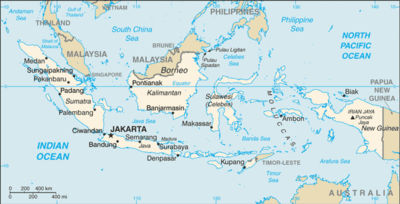
Source: CIA World Factbook (public domain)
Geography
note 1: 13,466 islands are in the archipelago, of which 922 are permanently inhabited; Indonesia is the world's largest country composed solely of islands; the country straddles the equator and occupies a strategic location along major sea lanes from the Indian Ocean to the Pacific Ocean note 2: Indonesia is one of the countries along the Ring of Fire, which is a belt bordering the Pacific Ocean that contains about 75% of the world's volcanoes, up to 90% of the world's earthquakes, and 80% of tsunamisnote 3: despite having the fourth largest population in the world, Indonesia is the most heavily forested region on earth after the Amazon
Source: CIA World Factbook (public domain)
History
The archipelago was once largely under the control of Buddhist and Hindu rulers. By around the 7th century, a Buddhist kingdom arose on Sumatra and expanded into Java and the Malay Peninsula until it was conquered in the late 13th century by the Hindu Majapahit Empire from Java. Majapahit (1290-1527) united most of modern-day Indonesia and Malaysia. Traders introduced Islam around the 11th century, and the religion gradually expanded over the next 500 years. The Portuguese conquered parts of Indonesia in the 16th century, but the Dutch ousted them (except in East Timor) and began colonizing the islands in the early 17th century. It would be the early 20th century before Dutch colonial rule was established across the entirety of what would become the boundaries of the modern Indonesian state.Japan occupied the islands from 1942 to 1945. Indonesia declared its independence shortly before Japan's surrender, but it required four years of sometimes brutal fighting, intermittent negotiations, and UN mediation before the Netherlands agreed to transfer sovereignty in 1949. A period of sometimes unruly parliamentary democracy ended in 1957 when President SOEKARNO declared martial law and instituted "Guided Democracy." After an abortive coup in 1965 by alleged communist sympathizers, SOEKARNO was gradually eased from power. From 1967 until 1998, President SUHARTO ruled Indonesia with his "New Order" government. After street protests toppled SUHARTO in 1998, free and fair legislative elections took place in 1999 while the country's first direct presidential election occurred in 2004. Indonesia has since become a robust democracy, holding four direct presidential elections, each considered by international observers to have been largely free and fair. Indonesia is now the world's third-most-populous democracy and the world's largest Muslim-majority nation. It has had strong economic growth since overcoming the Asian financial crisis of the late 1990s. By the 2020s, it had the largest economy in Southeast Asia, and its economy ranked in the world's top 10 in terms of purchasing power parity. It has also made considerable gains in reducing poverty. Although relations amongst its diverse population--there are more than 300 ethnic groups--have been harmonious in the 2000s, there have been areas of sectarian discontent and violence, as well as instances of religious extremism and terrorism. A political settlement to an armed separatist conflict in Aceh was achieved in 2005, but a separatist group in Papua continued to conduct a low-intensity conflict as of 2024.
Source: CIA World Factbook (public domain)
Government
presidential republic. Independence: 17 August 1945 (declared independence from the Netherlands)
Source: CIA World Factbook (public domain)
Economy
upper middle-income, largest and growing Southeast Asian economy; higher lending rates to moderate inflation; ongoing relocation of capital fueling infrastructure projects; major tourism sector prompting green economy goals
Source: CIA World Factbook (public domain)
Suggested Reading
Adopt This Country
Will you help us keep the Indonesia page accurate and up to date?
Adopt This Country