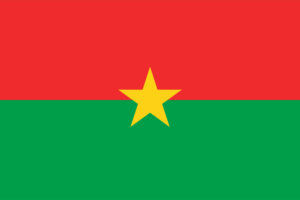
Burkina Faso
Many of Burkina Faso’s ethnic groups arrived in the region between the 12th and 15th centuries. The Gurma and Mossi peoples established several of the largest kingdoms in the area and used horse-mounted warriors in military campaigns.
Location
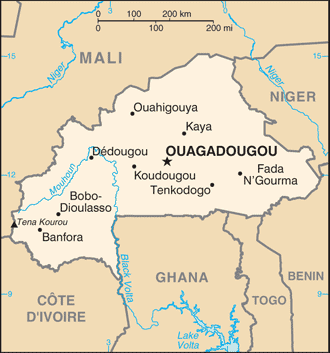
Source: CIA World Factbook (public domain)
Geography
landlocked savanna cut by the three principal rivers, the Black, Red, and White Voltas
Source: CIA World Factbook (public domain)
History
Many of Burkina Faso’s ethnic groups arrived in the region between the 12th and 15th centuries. The Gurma and Mossi peoples established several of the largest kingdoms in the area and used horse-mounted warriors in military campaigns. Of the various Mossi kingdoms, the most powerful were Ouagadougou and Yatenga. In the late 19th century, European states competed for control of the region. France eventually conquered the area and established it as a French protectorate. The country achieved independence from France in 1960 and changed its name to Burkina Faso in 1984. Repeated military coups were common in the country’s first few decades. In 1987 Blaise COMPAORE deposed the president, established a government, and ruled for 27 years. In 2014, COMPAORE resigned after protests against his repeated efforts to amend the constitution's two-term presidential limit. An interim administration led a year-long transition, organizing presidential and legislative elections. In 2015, Roch Marc Christian KABORE was elected president, and he was reelected in 2020. In 2022, the military conducted two takeovers: In January, army colonel Paul Henri DAMIBA overthrew KABORE in a coup d'etat, and then in September, army captain Ibrahim TRAORE deposed DAMIBA and declared himself transition president. The transition government planned to hold elections by July 2024, but they may be delayed due to security concerns.Terrorist groups -- including groups affiliated with Al-Qa’ida and the Islamic State -- began attacks in the country in 2016 and conducted attacks in the capital in 2016, 2017, and 2018. By early 2023, insecurity in Burkina Faso had displaced more than 2 million people and led to significant jumps in humanitarian needs and food insecurity. In addition to terrorism, the country faces a myriad of problems including high population growth, recurring drought, pervasive and perennial food insecurity, and limited natural resources. It is one of the world’s poorest countries.
Source: CIA World Factbook (public domain)
Government
presidential republic. Independence: 5 August 1960 (from France)
Source: CIA World Factbook (public domain)
Economy
highly agrarian, low-income economy; limited natural resources; widespread poverty; terrorism disrupting potential economic activity; improving trade balance via increases in gold exports; economy inflating after prior deflation; growing public debt but still manageable
Source: CIA World Factbook (public domain)
Suggested Reading
Adopt This Country
Will you help us keep the Burkina Faso page accurate and up to date?
Adopt This Country