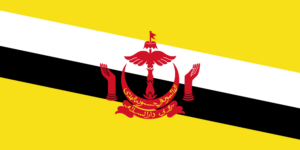
Brunei
The Sultanate of Brunei's influence peaked between the 15th and 17th centuries, when its control extended over coastal areas of northwest Borneo and the southern Philippines.
Location
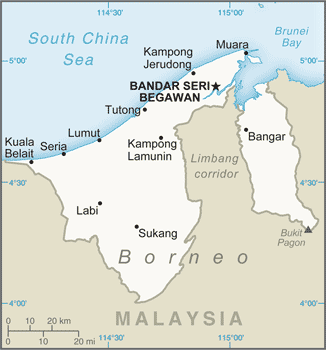
Source: CIA World Factbook (public domain)
Geography
close to vital sea lanes through South China Sea linking Indian and Pacific Oceans; two parts physically separated by Malaysia; the eastern part, the Temburong district, is an exclave and is almost an enclave within Malaysia
Source: CIA World Factbook (public domain)
History
The Sultanate of Brunei's influence peaked between the 15th and 17th centuries, when its control extended over coastal areas of northwest Borneo and the southern Philippines. Internal strife over royal succession, colonial expansion of European powers, and piracy subsequently brought on a period of decline. In 1888, Brunei became a British protectorate; independence was achieved in 1984. The same family has ruled Brunei for over six centuries, and in 2017, the country celebrated the 50th anniversary of Sultan Hassanal BOLKIAH’s accession to the throne. Brunei has one of the highest per-capita GDPs in the world, thanks to extensive petroleum and natural gas fields.
Source: CIA World Factbook (public domain)
Government
absolute monarchy or sultanate. Independence: 1 January 1984 (from the UK)
Source: CIA World Factbook (public domain)
Economy
almost exclusively an oil and gas economy; high income country; expansive and robust welfare system; the majority of the population works for the government; promulgating a nationalized halal brand; considering establishment of a bond market and stock exchange
Source: CIA World Factbook (public domain)
Suggested Reading
Adopt This Country
Will you help us keep the Brunei page accurate and up to date?
Adopt This Country