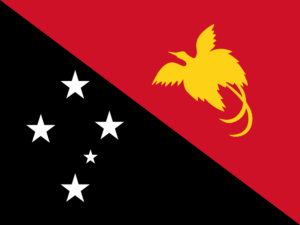
Papua New Guinea
The Country of the Week

Quick Facts
- Capital
- Port Moresby
- Population
- 10,273,996 (2025 est.)
- Area
- 462,840 sq km
- Government
- parliamentary democracy under a constitutional monarchy; a Commonwealth realm
- Languages
- Tok Pisin (official), English (official), Hiri Motu (official), some 839 living indigenous languages are spoken (about 12% of the world's total)
- Religions
- Protestant 64.3% (Evangelical Lutheran 18.4%, Seventh Day Adventist 12.9%, Pentecostal 10.4%, United Church 10.3%, Evangelical Alliance 5.9%, Anglican 3.2%, Baptist 2.8%, Salvation Army 0.4%), Roman Catholic 26%, other Christian 5.3%, non-Christian 1.4%, unspecified 3.1% (2011 est.)
- Ethnic Groups
- Melanesian, Papuan, Negrito, Micronesian, Polynesian
- Currency
- kina (PGK)
- Life Expectancy
- 70.1 years (2024 est.)
- Internet Domain
- .pg
- Climate
- tropical; northwest monsoon (December to March), southeast monsoon (May to October); slight seasonal temperature variation
- Terrain
- mostly mountains with coastal lowlands and rolling foothills
- Natural Resources
- gold, copper, silver, natural gas, timber, oil, fisheries
- Major Exports
- natural gas, gold, copper ore, palm oil, nickel (2023)
Source: CIA World Factbook (public domain)
Overview
Papua New Guinea (PNG) occupies the eastern half of the island of New Guinea; the western half is part of Indonesia. PNG was first settled between 50,000 and 60,000 years ago.