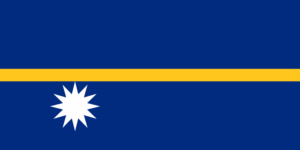
Nauru
The Country of the Week

Quick Facts
- Capital
- no official capital; government offices in the Yaren District
- Population
- 9,930 (2025 est.)
- Area
- 21 sq km
- Government
- parliamentary republic
- Languages
- Nauruan 93% (official, a distinct Pacific Island language), English 2% (widely understood, spoken, and used for most government and commercial purposes), other 5% (includes Gilbertese 2% and Chinese 2%) (2011 est.)
- Religions
- Protestant 60.4% (Nauruan Congregational 34.7%, Assemblies of God 11.6%, Pacific Light House 6.3%, Nauru Independent 3.6%, Baptist 1.5, Seventh Day Adventist 1.3%, other Protestant 1.4%), Roman Catholic 33.9%, other 4.2%, none 1.3%, no answer 0.3% (2021 est.)
- Ethnic Groups
- Nauruan 94.6%, I-Kiribati 2.2%, Fijian 1.3%, other 1.9% (2021 est.)
- Currency
- Australian dollars (AUD)
- Life Expectancy
- 68.6 years (2024 est.)
- Internet Domain
- .nr
- Climate
- tropical with a monsoonal pattern; rainy season (November to February)
- Terrain
- sandy beach rises to fertile ring around raised coral reefs with phosphate plateau in center
- Natural Resources
- phosphates, fish
- Major Exports
- fish, phosphates (2023)
Source: CIA World Factbook (public domain)
Overview
By 1000 B.C., Micronesian and Polynesian settlers inhabited Nauru, and the island was divided among 12 clans. Nauru developed in relative isolation because ocean currents made landfall on the island difficult.