
Mali
The Country of the Week
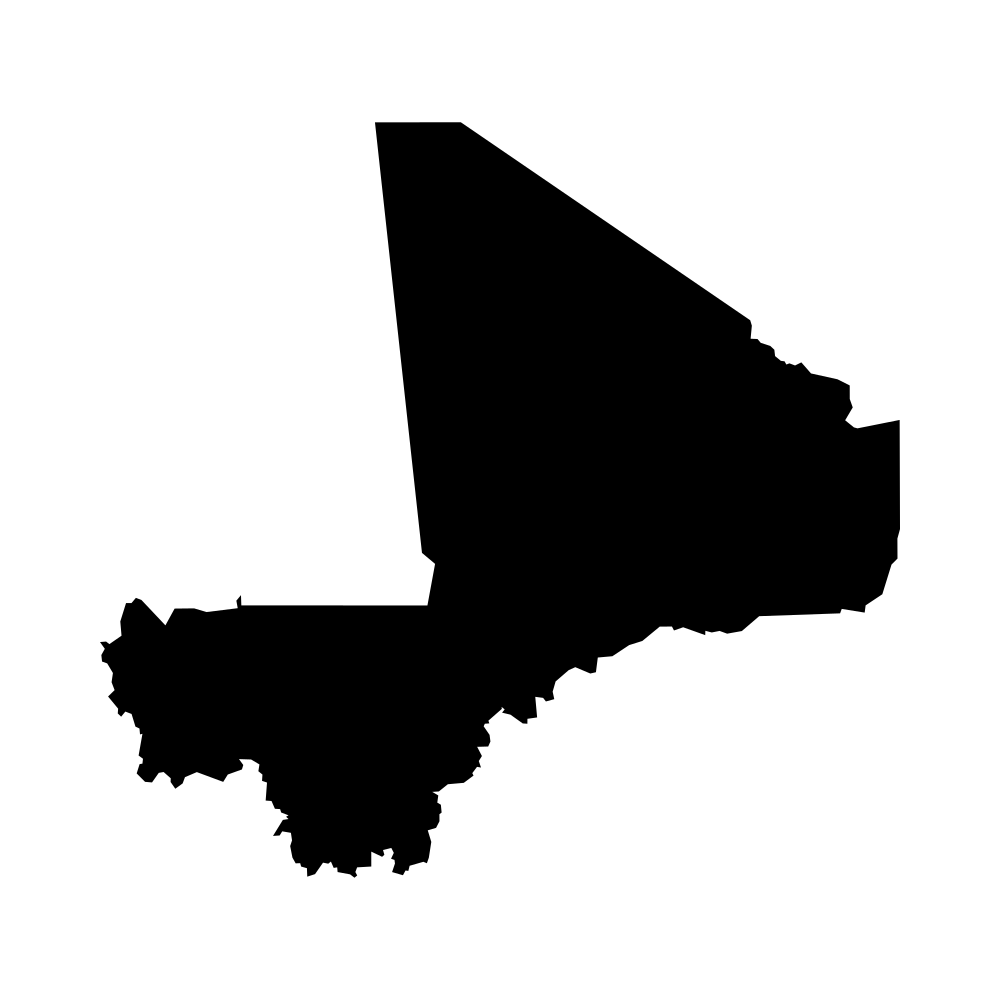
Quick Facts
- Capital
- Bamako
- Population
- 22,634,423 (2025 est.)
- Area
- 1,240,192 sq km
- Government
- semi-presidential republic
- Languages
- Bambara (official), French 17.2%, Peuhl/Foulfoulbe/Fulani 9.4%, Dogon 7.2%, Maraka/Soninke 6.4%, Malinke 5.6%, Sonrhai/Djerma 5.6%, Minianka 4.3%, Tamacheq 3.5%, Senoufo 2.6%, Bobo 2.1%, other 6.3%, unspecified 0.7% (2009 est.)
- Religions
- Muslim 93.9%, Christian 2.8%, animist 0.7%, none 2.5% (2018 est.)
- Ethnic Groups
- Bambara 33.3%, Fulani (Peuhl) 13.3%, Sarakole/Soninke/Marka 9.8%, Senufo/Manianka 9.6%, Malinke 8.8%, Dogon 8.7%, Sonrai 5.9%, Bobo 2.1%, Tuareg/Bella 1.7%, other Malian 6%, from members of Economic Community of West Africa 0.4%, other 0.3% (2018 est.)
- Currency
- Communaute Financiere Africaine francs (XOF)
- Life Expectancy
- 63.2 years (2024 est.)
- Internet Domain
- .ml
- Climate
- subtropical to arid; hot and dry (February to June); rainy, humid, and mild (June to November); cool and dry (November to February)
- Terrain
- mostly flat to rolling northern plains covered by sand; savanna in south, rugged hills in northeast
- Natural Resources
- gold, phosphates, kaolin, salt, limestone, uranium, gypsum, granite, hydropower
- Major Exports
- gold, cotton, oil seeds, fertilizers, gum resins (2023)
Source: CIA World Factbook (public domain)
Overview
Present-day Mali is named after the Mali Empire that ruled the region between the 13th and 16th centuries. At its peak in the 14th century, it was the largest and wealthiest empire in West Africa and controlled an area about twice the size of modern-day France.