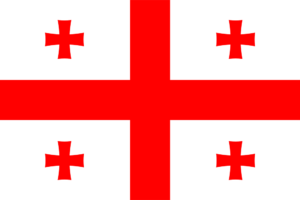
Georgia
The Country of the Week

Quick Facts
- Capital
- Tbilisi
- Population
- 4,900,961 (2024 est.)
- Area
- 69,700 sq km
- Government
- semi-presidential republic
- Religions
- Eastern Orthodox Christian (official) 83.4%, Muslim 10.7%, Armenian Apostolic Christian 2.9%, other 1.2% (includes Roman Catholic Christian, Jehovah's Witness, Yazidi, Protestant Christian, Jewish), none 0.5%, unspecified/no answer 1.2% (2014 est.)
- Ethnic Groups
- Georgian 86.8%, Azeri 6.3%, Armenian 4.5%, other 2.3% (includes Russian, Ossetian, Yazidi, Ukrainian, Kist, Greek) (2014 est.)
- Currency
- laris (GEL)
- Life Expectancy
- 72.8 years (2024 est.)
- Internet Domain
- .ge
- Climate
- warm and pleasant; Mediterranean-like on Black Sea coast
- Terrain
- largely mountainous with Great Caucasus Mountains in the north and Lesser Caucasus Mountains in the south; Kolkhet'is Dablobi (Kolkhida Lowland) opens to the Black Sea in the west; Mtkvari River Basin in the east; fertile soils in river valley flood plains and foothills of Kolkhida Lowland
- Natural Resources
- timber, hydropower, manganese deposits, iron ore, copper, minor coal and oil deposits; coastal climate and soils allow for important tea and citrus growth
- Major Exports
- cars, copper ore, electricity, garments, wine (2023)
Source: CIA World Factbook (public domain)
Overview
The region of present-day Georgia once contained the ancient kingdoms of Colchis (known as Egrisi locally) and Kartli-Iberia. The area came under Roman influence in the first centuries A.D., and Christianity became the state religion in the 330s.