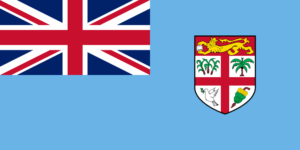
Fiji
The Country of the Week

Quick Facts
- Capital
- Suva (on Viti Levu)
- Population
- 951,611 (2024 est.)
- Area
- 18,274 sq km
- Government
- parliamentary republic
- Languages
- English (official), iTaukei (official), Fiji Hindi (official)
- Religions
- Protestant 45% (Methodist 34.6%, Assembly of God 5.7%, Seventh Day Adventist 3.9%, and Anglican 0.8%), Hindu 27.9%, other Christian 10.4%, Roman Catholic 9.1%, Muslim 6.3%, Sikh 0.3%, other 0.3%, none 0.8% (2007 est.)
- Ethnic Groups
- iTaukei 56.8% (predominantly Melanesian with a Polynesian admixture), Indo-Fijian 37.5%, Rotuman 1.2%, other 4.5% (European, part European, other Pacific Islanders, Chinese) (2007 est.)
- Currency
- Fijian dollars (FJD)
- Life Expectancy
- 74.8 years (2024 est.)
- Internet Domain
- .fj
- Climate
- tropical marine; only slight seasonal temperature variation
- Terrain
- mostly mountains of volcanic origin
- Natural Resources
- timber, fish, gold, copper, offshore oil potential, hydropower
- Major Exports
- water, fish, raw sugar, refined petroleum, garments (2023)
Source: CIA World Factbook (public domain)
Overview
Austronesians settled Fiji around 1000 B.C., followed by successive waves of Melanesians starting around the first century A.D. Fijians traded with Polynesian groups in Samoa and Tonga, and by about 900, much of Fiji was in the Tu’i Tongan Empire’s sphere of influence.