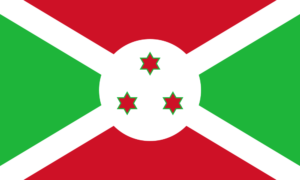
Burundi
The Country of the Week

Quick Facts
- Capital
- Gitega (political capital), Bujumbura (commercial capital)
- Population
- 13,590,102 (2024 est.)
- Area
- 27,830 sq km
- Government
- presidential republic
- Religions
- Christian 93.9% (Roman Catholic 58.6%, Protestant 35.3% [includes Adventist 2.7% and other Protestant religions 32.6%]), Muslim 3.4%, other 1.3%, none 1.3% (2016-17 est.)
- Ethnic Groups
- Hutu, Tutsi, Twa, South Asian
- Currency
- Burundi francs (BIF)
- Life Expectancy
- 68.1 years (2024 est.)
- Internet Domain
- .bi
- Climate
- equatorial; high plateau with considerable altitude variation (772 m to 2,670 m above sea level); average annual temperature varies with altitude from 23 to 17 degrees Celsius but is generally moderate; average annual rainfall is about 150 cm with two wet seasons (February to May and September to November) and two dry seasons (June to August and December to January)
- Terrain
- hilly and mountainous, dropping to a plateau in east, some plains
- Natural Resources
- nickel, uranium, rare earth oxides, peat, cobalt, copper, platinum, vanadium, arable land, hydropower, niobium, tantalum, gold, tin, tungsten, kaolin, limestone
- Major Exports
- gold, coffee, tea, tin ores, iron bars (2023)
Source: CIA World Factbook (public domain)
Overview
Established in the 1600s, the Burundi Kingdom has had borders similar to those of modern Burundi since the 1800s.